Humanism in India today

 India
 

Humanism in India today

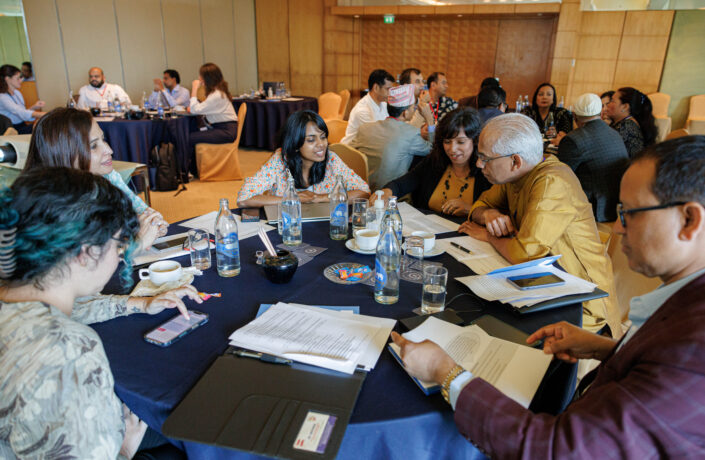
As a consequence of the International and Humanist Ethical Union holding a Board Meeting in Bombay all the major Indian humanist organisations held international conferences around the beginning of the year. The Indian Rationalist Association ran the International Rationalist Conference 27-31 December 1995. The Indian Radical Humanist Association organised an international seminar on Integrated Human Development in South Asia- Problems and Perspectives 3-5 January 1996. The Fourth World Atheist Conference was held 4-6 January at the Atheist Centre in Vijayawada. Jim Herrick attended these conferences together with the IHEU Board Meeting and found humanism thriving in India. There were also events held by the Indian Humanist Union in Delhi and by the Periyar Self Respect movement in Madras.


The Indian Rationalist Association

THE Indian Rationalist Association was founded in 1949 to 'promote the spread of rationalism, defined as an attitude which unreservedly accepts the supremacy of reason and aims at establishing a system of philosophy and ethics verifiable by experience, independent of all arbitrary assumptions of authority'. It was a successor to the Rationalist Association of India founded in 1930 and influenced by the British Rationalist Press Association. It was weakened by the Second World War and Quit India Movement, but re-formed in 1949. The Association has been very active in undermining superstition and in defence of freedom of speech.

The IRA International Conference held in New Delhi gained national coverage for two reasons: first, the hope was that Taslima Nastin would attend, but it transpired that the Indian Government refused to grant her a visa; second, a fire walking event in which rationalists walked bare foot on burning charcoal to 'show that walking on fire is not a miracle but involves only scientific knowledge and methodology' (The Times of India, 29 December 1995). It was attended by conferees from Norway, Finland, Germany, the USA, Britain and Holland.

The conference was organised into two parts: 'Transformation of Traditional Societies' and 'Freedom of Expression'. In an opening ceremony Levi Fragell, editor of the Norwegian journal Humanist, spoke of the links between Scandinavia and India in aiding Taslima Nasrin to escape from Bangladesh. He said we needed more rationalism in the world and commented on the fact that President Clinton of the USA had had ten religious people lay their hands on him. A ceremony of lighting candles inaugurated the conference.

Joseph Edamaraku gave a brief account of the history of the Indian Rationalist Association. Professor Panikar said that we are at present being deluged with obscurantist thought. The idea of India as a spiritual and religious country is a clich6, he observed. He commented on the materialist heritage of India, to be found in the Upanishads and the Lokayata writings. These ideas had been debased by the priestly class: 'all systems of religion are systems of deception'.

Professor Rob Tielman, a co-President of IHEU, emphasised the importance of the II-lEU. There was still discrimination in Europe against atheists and humanists. There was a struggle to create a secular European Union, but the Vatican is working for a Christian Union. The Vatican should be a church and not a state, the separation of church and state is essential for all people to live peaceably together.

Dr Harry Stopes-Roe spoke about the tradition of humanism from the ancient Greeks to the Enlightenment and the current day. He emphasised the importance of David Hume and also of the British empirical tradition.

Jane Wynne Willson, a co-President of IHEU, spoke on the 'Role of Alternative Ceremonies in Transforming Societies'. She said ritual is a basic human need, that ritual can be divorced from religion, and that secular ceremonies can make a positive contribution to society.

Nehsi Karim, Associate Professor, Department of Sociology, University of Dhaka and Secretary General, Assembly of Freethinkers, Bangladesh, talked about transforming societies in relation to Bangladesh. A freethought movement had existed in Bangladesh in the late twenties; it continued but was very weak, although secularism was once a fundamental of the constitution. After an army coup (1975) the government became fundamentalist, which was reinforced by the new government in 1988. The population is 80 per cent rural and 75 per cent illiterate, which gives the government the possibility of manipulating people's views. There are very few human rights organisations in Bangladesh. The freethought movement is in its infancy and quick changes could not be expected.

Professor Omchery N.N. Pillai talked about the model of society in Kerala (South India). Personal fulfilment in helping others could be developed into social reform; for instance a personal encounter with an 'untouchable' led him to campaign against the caste system. The example of change in Kerala was remarkable. The highest level of education, health care, and literacy in India showed change can be brought about. 'Despair is the worst form of bondage' {Rabindranath Tagore).

Prakash Narsin, leader d the Humanist Union, spoke d the need to find a balance between traditional and modern societies: 'the balance to be struck between continuity and change is a delicate one'. The caste system, which had begun as a tool for division of labour, has led to great injustices and atrocities The denial of the rights of women and the mistreatment of Hindu widows demonstrate the damage of religion to the community. In Islam there was hostile treatment of non-Muslims and injustice to women especially in relation to divorce. 'Uncritical acceptance of ancient religious concepts invades the moral and emotional health of the people.. .' For instance the Hindu doctrine of Karma undermined people's development of self-reliance. In development of ethical values, children should be introduced to acceptance of uncertainty, of tolerance and empathy. 'As far as methods of inquiry are concerned reason should be used as the sole instrument. (It does not mean that emotions or even mystical experience is not to be taken into account.) We must work together to bring about change.

In the session on Freedom of Expression, Rob Tielman emphasised that freedom of expression included non-verbal aspects, e.g. wearing headscarves, and involved the principle of self-determination. We must be intolerant of those who are intolerant. Jim Herrick spoke on 'Freedom of speech as a universal human right'. (see p. 11)

Foils Elders, Professor of Philosophy at the University of Humanism, Utrecht, said that humanism had been enriched by the culture of India. Alexander the Great had two teachers, the Greek Aristotle and an Indian gum. Arab humanism from the 8th to the 12th century AD was essential to the development of the Renaissance. Socrates and the Buddha were comparable in their empirical observation, questioning, and observation on suffering. Humanism is a multi-cultural phenomenon. Humanism should be broad and inclusive, so that a liberal Muslim or a Christian in sympathy with a humanist position should be allowed to participate.

M. A. Babe, Member of Parliament, New Delhi, said he was happy to be associated with the IRA's campaign for freedom of speech. There should be the right to expose fraud and superstition, but not to impose ideas on others. He had reservations about provocative attacks on religion, but endorsed the need to counter an intolerable growth of intolerance.

During the Conference two new organisations were inaugurated: the International Alliance against Fundamentalism and the Asian Rationalist Federation. There were also cultural and social events.

Indian Radical Humanist Association

THE Indian Radical Humanist Association goes back to 1920 and evolved with the evolution of M. N. Roy's intellectual development, though several others contributed to that process. M. N. Roy was initially a Marxist, but during his imprisonment by the British in the 1931-1936 he announced that 'a philosophical revolution must precede a social revolution' and founded the Radical Humanist Association. This was initially a political party taking part in the Indian National Congress and working for independence. The Royists broke away from the Congress, disagreeing over their attitude to the Second World War in which Roy thought they should support the Anti-Fascist Cause.

The Radical Democratic Party was inaugurated in 1940 and aimed for a 'comprehensive programme of social reconstruction'. Roy issued a draft constitution in which people's committees in the villages were to be given power with the Congress at the apex. The Indian Renaissance Institute was set up to study social change. A statement in 1943 declared: 'At no other time in human history has the play of irrational forces been so organised, so widespread and so destructive as today. The exploitation of ignorance, suppression of freedom of thought and expression, racial arrogance, organised cultivation of irrational forces, mass hysteria, superstition and bigotry are but a few dismal features of contemporary existence'.

The Radical Democratic Party was disbanded in the belief that political parties would not bring about social change. The Indian Radical Humanist Association was formed in 1969 with the aim of bringing about change at the grass-roots level.

The conference was held in a large new centre being built in co-operation with The Centre for the Study of Social Change, the Streehitakarini (a group to bring health and contraceptive information to women in the slums of Bombay) and the Indian Radical Humanist Association. The Centre will be the largest humanist centre in the world.

Sessions of the conference were held on Socio-Cultural Problems of South Asia, Economic Problems of South Asia, Political Problems, Integrated Human Development, and Practical Programme for Human Development.

Integrated human development

Dr Indumati Parikh, a leader of the IRHA and the Streethitakarini, welcomed visitors to the M.N. Roy Memorial Development Campus and said that they were launching the South Asian Humanist Centre for networking of humanist, rationalist and secularist movements. She spoke of the need for people to understand their problems, analyse them and help each other to solve them. 'We need interdisciplinary research to discover our rational heritage', we have to launch a massive drive for non-formal education for our masses...

V.M. Tarkunde, a retired High Court Judge and much respected leader in the IRHA, discussed the humanist approach to politics: 'In many post-colonial countries', he said, 'democracy was replaced by dictatorial regimes and democracy almost disappeared ~m India in 1975 when Mrs Gandhi took emergency powers.' 'At present Indian democracy, is being threatened from a different direction. A Hindu chauvinist party (the BJP) which also claims to be ardently nationalistic, has a chance of coming to power in New Delhi. A party which combines religious chauvinism with aggressive nationalism is likely to establish a Fascist regime of an Indian variety'.

He urged that this must be resisted and that humanism must provide the subsoil in which democracy can be sustained. However, he thought that 'democracy as it is developed in Western Europe and America is essentially superficial. It provides for the rule, not of the people, but of political parties which claim to represent them ... a genuine democracy requires a radical decentralisation of power. The State should consist of a network of local republics which may be called People's Committees, that as much power as is possible should be invested in the primary People's Committee, that power which is required to be exercised at higher levels of government should be in the hands of persons who are the real representatives of the people and who are subject to their control and recall and that Parliament should be the apex of such People's Committees and intermediate centres of power.'

Professor V.K. Sinha, editor of the Secularist continued by talking about the crisis in Indian politics. He predicted that 'The RIP which is a communal Party, with its saffron brigade comprising the RSS, the Hindu Vishwas Parishad, the Bajrang Dal and a host of other Hindu fundamentalist groups might capture, if not political power at the centre, at least the power to determine the social and political agenda in the coming decade... It is in the fundamentalism and nationalism which the saffron brigade presents that contemporary India faces its greatest threat and challenge... This poses the gravest challenge to the humanists and secularists in India.'

Dr Ganri Bazaz Malik spoke of women's issues in South Asia. She thought that the world was awakening to the position of the poor and illiterate, of which women with their children are the major part. This region has been a male-dominated part of the world. 'Crushing poverty overlaid with longstanding patterns of discrimination create conditions for women which threaten their well-being, curtail their social, political, economic rights and limit their opportunities.' Agriculture still constitutes the livelihood of 80-90 per cent in South Asia and women undertake the greater part of this work.

There has been a tradition of women playing a full part in the Vedic tradition and in the early part of the nationalist movement. But there has been a continuing loss of women's status... The dowry system means that mothers abort or kill girl children to avoid a large payment on marriage. Population control is necessary but should be brought about in an enlightened way: 'A mass campaign for literacy, land reform, health education, which would have ensured an overall development and education, would check the population in a natural way.'

She concluded by quoting Gandhi: 'Prejudices cannot be removed by legislation. They yield only to patient toil and education'. The Beijing U.N. Conference for women in September 1995, identified and highlighted education as the field for NGOs who work at the grassroots level. It is only through them that integrated human development can have a future.'

Dr Ramendra, of the Department of Philosophy Patna College, Patna, said that 'Communalism and the caste-system are, in my opinion, two major obstacles which prevent integrated human development in the South Asian region'. He considered that 'because communalism is linked to fundamentalism and religious identities, promotion of rationalism and humanism alone can provide a lasting solution to the problem of communalism. We must attack the fundamentalism of all religions in order to destroy the root cause of communalism.'

Fourth World Atheist Conference

The conference was held at the Atheist Centre, Vijayawada. The Atheist Centre was founded by Gora and Saraswathi Gora in 1940 in the village of Mudunur, but in 1947 shifted to Vijayawada, where it has become world-famous for its combination of the atheist outlook and social work. Cora's family have continued his work and the organisation is run as an extended family co-operative. It has a comprehensive approach for sustainable development. 'It views life as an integrated whole and is striving to build an alternate way of life, a life stance based on a secular-humanist-atheist alternative.'

The Centre offers counselling for the development of self-autonomy, actively opposes the caste system and conducts intercaste marriages, criticises religious taboos and organises beef and pork suppers at which both Hindu and Muslim supporters can be challenged, acts to help child prostitutes and to oppose child marriages. The Centre also conducts a campaign to promote the scientific outlook and rational thinking; for instance, regular science exhibitions are held. Witchcraft and sorcery, which survive in rural life, are exposed with the co-operation of the Indian Medical Association. The Centre aims to spread environmental consciousness and ecological concern.

An associated organisation - the Arthik Samata Mandal (Association for Economic Equality) -- is devoted to comprehensive rural development. The work includes health, education, mother and child care, polio corrective surgery, rural eye camps, waste land development, poverty alleviation programmes. Many of those attending the conference were given a day trip into the rural areas where this work was carried out; they were very impressed by this remarkable achievement.

Attached to the Atheist Centre is a Working Women's Hostel and a home for women with social problems. Two other projects are the socio-psychological rehabilitation of ex-criminals and the eradication of the Jogin system of child temple prostitutes.

Positive Atheism for a Positive

Future

The conference was organised together with the Dravidar Kazhagam, the institution of the Periyar Self-Respect movement. The movement is anti-caste and anti-god. The General Secretary, K. Veeramani, delivered a welcome address in which he declared: 'The oncoming century will be definitely a century of fast-growing science which will result in the triumph of atheism and equality. The atheists have ample scope and prospects for the furtherance of activities and betterment of society. Every atheist today is a potential liberator of a section of humanity from the shackles of injustice, inequality, superstition, maladjustment with fellow-beings, wastage of money, time and energy, and lack of reasoning power and freedom of expression.'

He quoted the founder of his movement, Periyar: 'The aim of a genuine Self-Respect Movement is to change whatever appears to be adverse to one's feeling of self-respect. That which enslaves you to customs, to orthodoxy and to the rigours of religion is contrary to your rationality and awareness of self-respect based on feelings of dignity and indignity.'

Sir Hermann

Bondi (President of the RPA) began by alluding to the title and emphasising that, 'Ours is a positive faith, strengthening and unifying... We should rise above the divisions of religion to become a unifying force. Religious people who went around saying "I know everything" are arrogant. The positive attitude requires a commitment to democracy. Our human lot is uncertainty, and we must criticise the infantile belief that there can be absolute certainty.'

'We atheists are still a minority, but the power of reason and persuasion is great. We must reason with the religious and bring our positive values even to those who are stubborn in their delusions. To be human means to be in co-operation with others. We must value our neighbours across all categories. Yet we must stand up for our non-belief- the positive work of the Atheist Centre is a splendid example.'

Saraswathi

Gora, co-founder of the Atheist Centre, said that 'Human welfare is of paramount importance for us. Atheism is universal, transcending all boundaries. It is human centred. It aims for all round development of the personality. Human freedom and human dignity must be achieved ... Atheism is not an armchair philosophy or mere criticism of god or religion. It is a way of life to increase the moral freedom of the individual. Atheism is comprehensive in its approach and outlook.'

Lavanam, a co-convener of the conference, pointed to those pessimistic religious people who on the approach of the second millennium prophesied Armageddon and Doomsday and said that on the contrary we needed to give hope to humanity that the future would be bright and positive. Today's atheists have a double role to play: they have to save humanity from pessimistic adventurism and to invent and promote tools to build a positive future in every walk of life. Now it is the responsibility of atheists to take positive strides towards promoting universal humanism and universal human identity without which it would become impossible to save even our physical and social environment. We must work with liberal minded non-atheists in common cause. Atheists have a responsibility of restructuring the unjust and exploitative cultural, moral, social, political institutions and ideas and values, at local, national and international levels.

Jim

Herrick, editor of the New Humanist and International Humanist News, said we must take a realistic approach to the positive and negative elements of human beings. 'We must nurture the positive side of our atheistic existence by fully facing our negative potentiality. Religious extremism can make people override their natural moderation. There can be no such thing as humanist extremism. As well as reason and atheism we need 'a sense of values, and of ritual and ceremonies, a sense of the meaning of life and a sense of awe and wonder.

'One area of hope is that human beings have extraordinary and creative solutions to social problems, the discoveries of science, and the wellspring of vitality which we receive from the arts. The arts can enlarge our sympathies and understanding of other people and lead us beyond our own limited selves. A primary need for democracy, social change, science is education.

'Extremist religion and fundamentalism, whether from the Christian Moral Right or from Islam, are growing in the world. We must on no account demonise the Muslims. I have met tolerant and civilised Muslims, the Sufi tradition of art and mysticism is fine, and many artistic endeavours are superb. We must keep in dialogue and encourage the liberals.

'The future towards which positive atheism moves is:

Not bound by ties of caste and creed

nor kept in the cages of their self-made bars

I call myself a citizen of the world

No matter what others may prefer to call me.

(Joshua, a distinguished Telegu poet)

Declaration

The conference ended with a declaration which encapsulated the ideas of the conference:

We are on the threshold of the twenty-first century and we are moving into a post-religious society. Universal problems require a universal attitude, which should be scientific and humanistic. We need positive action and total reorientation of our outlook. We are one world and cherish our democratic methods.

We must work to increase human happiness, transcending the boundaries of clan, caste and gender. We will use democratic and secular methods in our efforts for social progress. AH progressive-minded people must oppose religious fundamentalism as it destroys the very roots of individual freedom and expression.

Morality is essential for positive atheism: it must consist of honesty, truthfulness, tolerance and peacefulness. Positive atheism is based on individual freedom and a realistic understanding of human nature. The media, politicians, and scientists must be aware of their social responsibility and should play a positive role to create a positive future.

Positive atheists will work for progress. This will not come about automatically: we must work, and act, and hope for it.

Indian Humanist Union

The Indian Humanist Union was founded by Narsingh Narain (1897-1972), who was a senior civil servant and magistrate. He retired from Government service to undertake social work and to promote freethought and the scientific approach to religion. The Society for the Promotion of Freedom of Thought was founded in 1954 and became the Humanist Union in 1960. The journal Humanist Outlook is now edited by his son Prakash Narain who leads the Humanist Union.

The keynote address at the Sixth Narsingh Namin Memorial Seminar in Delhi on 8 January 1996 was given by Jane Wynne Willson, a co-President of IHEU.