Superstition and Witchcraft in Africa

 Nigeria

“The witch cried yesterday and the child died today, who does not know that it was the witch that cried yesterday that killed the child who died today” Yoruba proverb.

In Africa, superstitions are common and widespread. They include absurd claims and conceptions. Crafted by primitive human beings, these irrational beliefs permeate all aspects of African thought and culture: family life, farming, trading, mining, politics, film industry, etc. And one of the most potent African superstitions is belief in witchcraft. Most Africans believe in sorcerers. They believe witches are real, active beings that act to influence, intervene and alter the course of human life for good or ill. Witchcraft is accepted as a mode of explanation, perception and interpretation of life, events, nature and reality. Witches are believed to cause poverty, disease, accidents, business failures, famine, earthquake, infertility and childbirth difficulties. Africans also attribute any extraordinary, mysterious or inexplicable phenomenon to sorcery. In some African communities there is even a talk about positive and negative witchcraft. While positive witchcraft is used to do good – cure diseases or solve problems – negative witchcraft is used to do evil. But generally in Africa witchcraft is associated with evil, harm and destruction.

The Human Connection

Africans believe sorcerers are spirits who carry out their nefarious activities as human beings, animals or insects. In countries like Nigeria, Cameroon, Ghana, Malawi and Uganda, witches are identified mostly with women or infants. In my country Nigeria all nocturnal insects and animals, especially birds, are suspected sorcerers. In the Gambia or Senegal, witches are associated with owls. Witches are believed to operate mainly in the night – they organise nocturnal meetings in the seas, oceans and forests where they allegedly feast on human blood, flesh or foetuses. The general belief is that sorcerers always convene to plan evil. They plot harm for people, especially their own family members. As a result of this, throughout Africa, witchcraft accusations in families are common. People blame their fathers, mothers, husbands, wives, children, uncles and aunts, grandfathers and grandmothers for any misfortune that befalls them even, even the ones they caused themselves.
In most cases these accusations have led to ostracism, persecution, torture, and inhuman and degrading treatment or outright liquidation of alleged witches.

Witch Hunting

While witch hunting is a thing of the past in Europe and the entire Western world, in Africa it is an ongoing activity. Attacks on witches, persecution and killings still take place. Most of the victims are women and children.
Recently there have several reported cases of witches being attacked or killed in different parts of the continent. In Eastern Cape of South Africa, a woman, her daughter, and grandson were hacked to death for allegedly practising witchcraft. In Ghana a woman – Samata Karim – was almost lynched by a mob on the suspicion that she was a witch. The mob pursued Samata after a neighbour had dreamt that Samata was strangling her to death.
In Uganda, three suspected witches were lynched in Kitgum. The women were accused of using witchcraft to kill a man in the district.
In 2004, in Edo State, Nigeria, 27 men and women suspected of witchcraft died after being forced to drink a local concoction believed to identify witches. And in June this year a 70-year-old man killed his son in Kaduna in Northern Nigeria, alleging that he had used witchcraft to kill his three children in quick succession. In Tanzania and Mozambique there have been reported incidents of killing, torture and maiming of suspected sorcerers.

Witch Confession

One of the most intriguing aspects of the belief in witchcraft is confession – the claim that sorcerers sometimes openly admit to having indulged in occult activities. Believers in witchcraft often cite and use this as a justification for attacking and persecuting supposed witches.
For instance in 1998 in Lagos, Nigeria, a middle-aged woman was stoned and later burnt to death after she allegedly confessed to having practised witchcraft. The woman reportedly claimed to have killed ten people, including her own children, as well as being responsible for the repatriation of her brother from Europe. As in all cases of witch confession, no-one tried to critically examine or confirm these claims. No one tried to find out whether this woman was mentally sound.
At best, witch confessions are elicited under duress by a mob or are made by individuals of questionable mental health.
Besides, in some cultures in Nigeria, witch confession is believed to be therapeutic. Among the Okpameri people in Southern Nigeria witch confession is believed to be curative. So those suffering prolonged and complicated ailments are urged “to confess and be healed”.

The Christian Confusion

As in other aspects of African life and society, Christianity has confused and complicated efforts to eradicate witchcraft and realise social and cultural progress. Indeed the belief in witchcraft predates the advent of Christianity. But over the centuries Christianity has spread while reinforcing and appropriating this primitive belief. Many churches in Africa organise fellowships and revival meetings to cast out demons and counteract their activities. The Bible enjoins believers to torture witches to death. And today Pentecostal churches, with their literalist approach to the Bible, are championing a new witch hunt in Africa. In 2003 at least 25 people suspected of being sorcerers were clubbed or hacked to death in Akwa Ibom State in Southern Nigeria. The killings started after some members of the Christian churches accused their congregation’s families of practising witchcraft and being responsible for any calamities that befell them. As a result, some children attacked their parents, grandparents and other relatives to elicit confessions of witchcraft. So Christians in Africa torture, persecute and kill those alleged to be witches because their Bible, not reason or common sense, tells them so.

Humanist Intervention

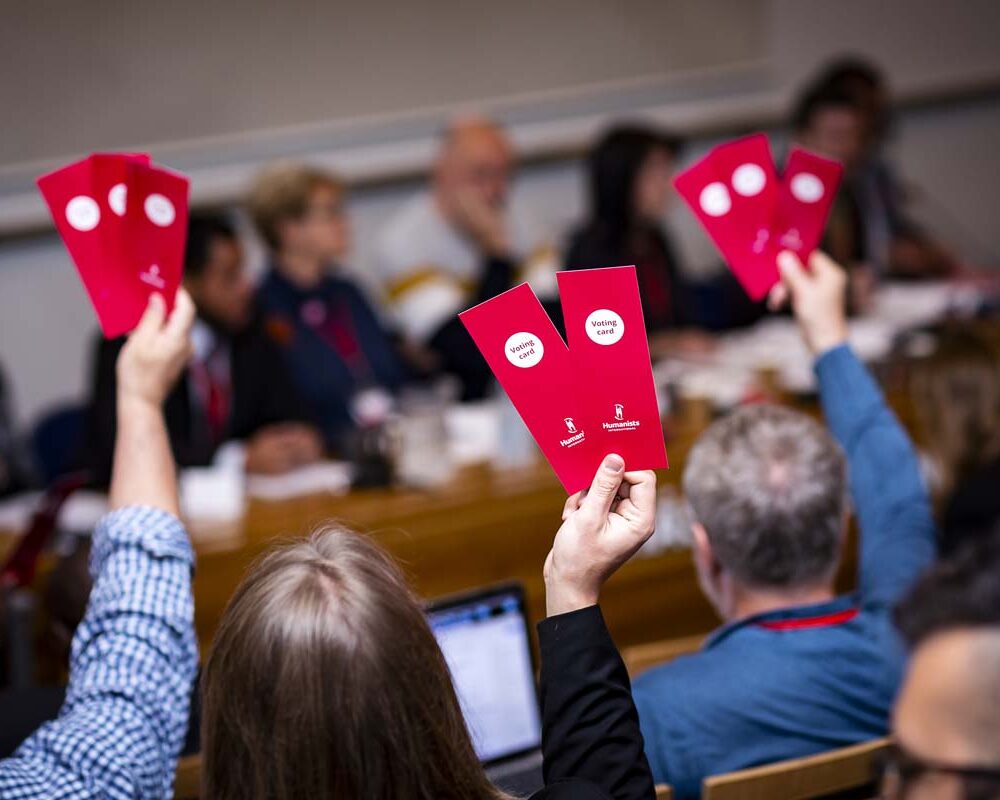
In August the Nigerian Humanist Movement (NHM) met in Port Harcourt for the 2007 Convention. The meeting was held at the Students’ Viewing Centre at the Rivers State University of Science and Technology. There were over 80 participants who came from several states: Benue, Cross River, Edo, Imo, Oyo, Osun, and Rivers.
The convention received goodwill messages from eminent Humanist individuals and groups worldwide: from the IHEU president Sonja Eggerickx, CFI Chairman Paul Kurtz, Richard Dawkins, Sam Harris, Victor Stenger, Bobbie Kirkhart, Mynga Futrell Roar Johnsen, Dick Cliiford, Norm Allen, Lori Lipman Brown, Roy Brown, Josh Kutchinsky. We got solidarity messages from the British Humanist Association, Humanist Association of Ireland, Gay and Lesbian Humanist Association, Iceland Ethical Humanist Association, Secular Nation Magazine, and from Humanist groups in Tanzania and Malawi.

Day One

The first day of the conference was devoted to youth and students, There were student/youth representatives from the Rivers State University of Science and Technology, University of Port Harcourt, University of Calabar, Rivers State College of Education, Imo State University, Owerri, Universal College of Science and Technology Ile Ife, Olabisi Onabanjo, University Ago Iwoye, University of Benin, etc. In my welcome address I expressed the solidarity of Nigerian Humanists with the people of Rivers State and the Niger Delta in their struggle for a clean safe, habitable and sustainable environment. Since the 1990s, the people of the Niger Delta have been campaigning for a reasonable share and control of the oil wealth which multinational companies exploit without fulfilling their corporate social responsibility. I expressed the hope that the civilised values of Humanism would take the place of conflict, kidnapping, hostage-taking, and bloodshed in the region. I urged Nigerian youths and students to discover the power in the Humanist outlook and free themselves from the bondage of religious dogma, illusions and superstitions.
NHM Chair Dr Enyeribe Onuoha gave a brillant presentation on Discovering the Power of Humanism. He stressed the importance of a worldview in the attempt to locate, relate, order, explain and interpret reality. According to Dr Onuoha, before the Age of Science, the mystical worldview based on dogma and revelation was dominant. But today the supernatural outlook is not only outdated but also untenable. He said the Humanist alternative rests on three pillars: naturalism, Humanist ethics and democracy. There was a session on Humanism and free thought on campuses. Youth/Campus activists discussed their efforts to promote Humanist and freethinking ideals. Marcel Iweajunwa, who leads a secular group, told us about his organisation: the New Nigeria Youth Organisation. His group works to enlighten and empower young people. He stressed the importance of Humanism in Nigerian youths’ quest for meaningful and productive lives.
Adewale Olugbenga discussed the mission and objectives of the newly founded group: Humanists Without Borders (HWB). HWB is a non-religious organisation that works to promote Humanism and free thought among youth and students. It plans to take the message of free thought to all campuses in Osun State and beyond.
Shedrach Nwachukwu described the situation of free thought at the University of Benin, especially the threat posed by Christian fundamentalism. Last year, at the NHM anniversary conference, some students came together to start a free thought group. But this group has not effectively taken off. Shedrach told us about the challenges freethinking students are facing as they try to mobilise and organise themselves.

Day Two

The second day of the conference focused on superstition and witchcraft. Dr Joseph Gbenda of the Benue State University in Markurdi made a presentation on witchcraft in Tiv society. Tiv is an ethnic group in Benue State in Northern Nigeria. According to Dr Gbenda, witchcraft, called locally tsav, is the foundation of traditional Tiv institutions, thought and culture. Interestingly, he said that witchcraft was largely seen as good and was attributed to individuals with extraordinary intelligence, power, talent or charisma. As he noted, this superstitious belief persists despite the growth and development of modern science.
Jimkelly Abegbe discussed belief in witchcraft among the Okpameris in Edo State. Unlike the Tivs, the Okpameris view witchcraft as evil. Witches are blamed for barrenness, storms, droughts, accidents, and disease. He faulted the process of witch testing and witch confession in his community, which he said lacked any basis in reason, science or common sense. Chibueze Okorie, a legal practitioner in Port Harcourt, delivered a paper on witchcraft and Nigerian law. As he rightly pointed out, it is illegal under Nigerian law to call oneself or some else a witch. But in spite of this provision, accusations of witchcraft are rampant. Mr Okorie noted that it was difficult to mount successful prosecutions, because of lack of evidence.
Etorobong Akpan, a doctoral student at the University of Calabar, identified witchcraft as a primitive attempt at explanation driven by instincts of fear and self-preservation. He argued that belief in witchcraft hindered genuine scientific thinking and research. “As long as this idea is allowed to persist, Africa will not experience a genuine scientific revolution,” he said. In the same vein, Mr John Edor, also of the University of Calabar, in his paper, “Superstition: An Impediment to Development”, observed that superstitious beliefs were the greatest obstacles to African civilisation and progress. He made it clear that “if development is to be achieved, then superstition must be expunged from the African cognitive space”.
The Convention was wrapped up with a World Humanist Day Lecture delivered by Mr Patrick Naagbanton, a journalist and human/environmental rights activist. A shortened version of Mr Naagbanton’s paper is given in the next article.
But it will still take some time for Nigerians or any Africans to accept his arguments, because Africa is currently going through a Dark Age. Theocracy, blind faith, superstition and witchcraft reign supreme. The conference presentations were intellectually engaging and mentally stimulating. The speakers challenged the basic assumptions of many participants and generated discussions that continued well after the sessions.
Even though the curfew and the general security situation in the city restricted our movement and caused readjustments to our timetable, the Port Harcourt convention was a success. It was Dr Joseph Gbenda of the Benue State University who summed up the feeling of most participants. He wrote " I must be frank: I enjoyed the conference."
Yes, the 2007 Convention of the NHM was a joyful experience.

Humanism in Action

After the convention we travelled to Umuchieze, a rural community in Imo State, where we met a couple who had almost been lynched by a Christian mob. In February, Gabriel and Celine Ogu were alleged to have indulged in witchcraft. Gabriel was accused of sucking the blood of infants in a local school where he works as a driver, while Celine was said to be responsible for the deaths of many family members including her own child. The villagers mobilised and wanted to lynch them but the prompt intervention of Dr Enyeribe Onuoha, NHM Chair and the traditional ruler of the community – who called the police – saved the lives of this couple.
At the end of the day, the mob destroyed the couple’s bicycle [1] and chairs, and cut down some food crops in the compound. With the support of the Center for Inquiry, Nigerian Humanists bought a new bicycle, four chairs and a bench, which were donated to the couple at a short ceremony at the Palace of Dr Onuoha. Humanists urged the couple to forgive and not to seek vengeance on anyone who might have aided or abetted the attack on them and the destruction of their property.

See this website: http://earthward.org/witchhunt.shtml for details of a similar attack and an appeal for help.