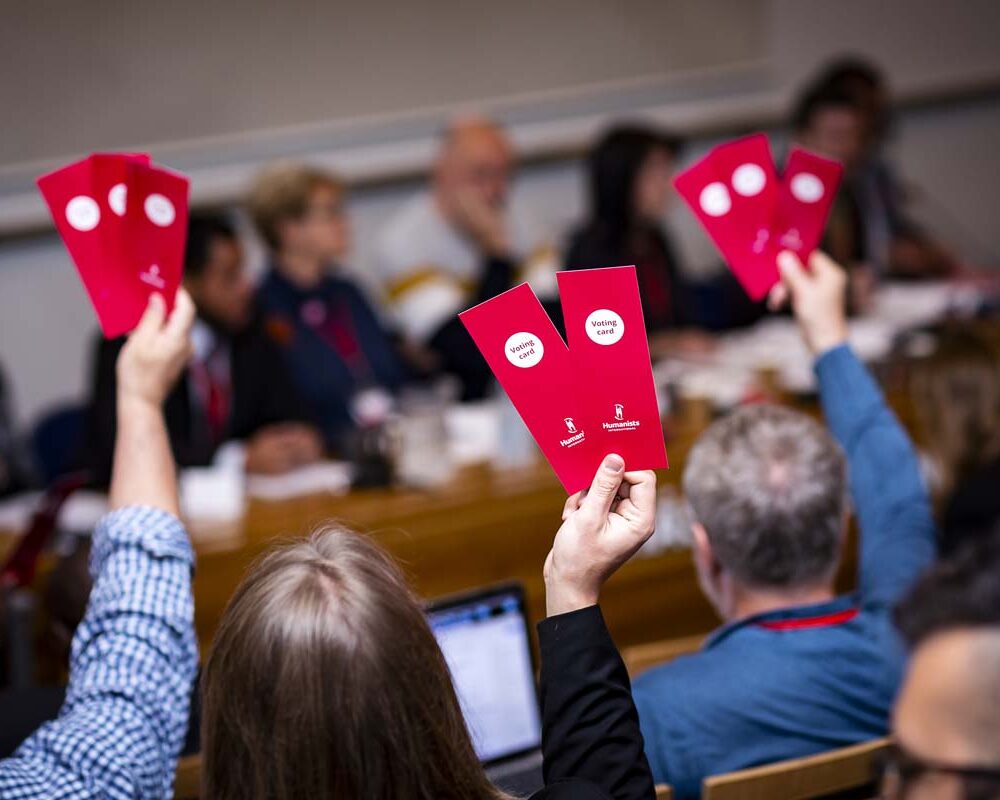
Humanism in Norway: interview with Roar Johnsen
The 12-month long 50th anniversary celebrations of the Norwegian Humanist Association (NHA) which started last year concluded recently. During an anniversary year crowded by adverts and articles in the media, conferences, seminars and social events, a ‘Norwegian Humanist Manifesto 2006’ was adopted, and a 536-page history of the Association was published by Prof. Paul Knutsen.
The main event was, of course, the gathering in the Oslo City Hall at the beginning of the celebrations. Among the guests were King Harald of Norway as Head of State, members of parliament, government ministers, and other distinguished guests (see photo on back cover). More than 500 people, including employees, local representatives, veterans etc. were present at a beautiful ceremony and celebration with music by the humanist choir. Levi Fragell received a special recognition and standing ovation for his stewardship of the organisation at the celebration.
Greetings came from the City of Oslo, the government, the Church of Norway, the Council for Religious and Life Stance Communities, and from the IHEU, represented by Roy Brown and Babu Gogineni.
Here, Roar Johnsen, president of the Norwegian Humanist Association since 2002 and a vice president of IHEU from 2006 talks to Babu Gogineni.
Babu Gogineni: Roar, the NHA is 50, and going strong. Tell us something about the organisation you head.
Roar Johnsen: When Christian Horn established the organisation in 1956 there were very few members. Today we have 25 people employed to work in all the 19 counties of Norway, and we have about 120 local humanist groups in the country. Another 25 employees take care of the administration in our headquarters in Oslo. The NHA is a leading force in Norwegian life and has a high profile presence in the media.
With 70,000 members, the organized Humanists in the country outnumber the Pentecostals and are almost twice the number of Catholics. We are becoming more attractive to people at a time when participation in church activities is slowing down and the faith base of the church is dwindling. Today many people belong to the Church simply because they were born into it.
Babu Gogineni: Seventy thousand members is a remarkable achievement for a national population of just 4.5 million, and we also know that over 13000 of your members are below 35 years of age. What role did civil confirmation ceremonies play in this increase in membership numbers? Is it true that civil confirmations now reach nearly 10% of the young, and that at least a quarter of the population have seen a Humanist ceremony in their life time?
Roar Johnsen: Yes, it is true. The civil confirmation ceremonies play an important role in our outreach. In addition to this, we have obtained the license to perform marriages. Even though initially we wanted the government themselves to perform all marriages through a mandatory civil ceremony, this was not possible. So we asked for equal rights with the churches to conduct marriages and we got it. We would very much like to, but we are still not permitted to perform same-sex marriage ceremonies or similar ceremonies.
Babu Gogineni: Where does Norway stand today in terms of Freedom of Religion or Belief?
Roar Johnsen: In 1814, Norway’s Constitution outlawed Jews, Jesuits and Atheists. The situation has improved since, but we are very unhappy that while Article 2 of the present Constitution guarantees freedom of religion, at the same time it declares “The religion of the state remains Evangelical-Lutheran. Inhabitants of that confession are committed to raising their children in the same.” Then Article 12 of the Constitution stipulates that at least 50% of the Prime Minister’s cabinet has to be members of the state church. Norway’s King is also required to be a member of the Lutheran Church – strangely, the head of the state is denied freedom of religion or belief!
The Norwegian Humanist Association’s aim is to separate Church and State, and to introduce liberty for all religions and life stances on equal terms.
Babu Gogineni: I think the first time we met was in 1998 at the Oslo Conference on Freedom of Religion or Belief at Holmen Kolmen. We Humanists had a real presence at the Conference, but you and several of your colleagues were wearing bright yellow T Shirts and demonstrating against Norway’s religious education policy. What was wrong, and what is the situation today?
Roar Johnsen: Some years ago, in a hugely backward step, the government introduced the KRL syllabus – the Christian Religion and Life Stance Education. These are supposedly non-denominational lessons and became mandatory. An exemption that we have had from attending these classes has been withdrawn. It is this unjust situation that we were protesting in Holmen Kolmen.
We approached the courts, but three times we lost the case in Norway. So we supported the four sets of parents who took their grievance to the UN and the three sets of parents who took their case to the European Court of Justice at Strasbourg.
Babu Gogineni:What was the outcome?
Roar Johnsen: The United Nations Humans Rights Committee found in our favour, and the state was obliged to change the way the classes were conducted. But then the UN Human Rights Commssion’s decisions are only advisory in nature.
As regards the Court in Strasbourg, a few months ago there was a Grand Chamber hearing at the court. A Grand Chamber hearing itself is significant and it may mean that the court will pass judgement on a matter of principle.
The Strasbourg proceedings were widely reported in the Norwegian media. The parents had 30 minutes to present their case, then the Norwegian State had 30 minutes as well to summarise the previously submitted written arguments.
The judges had several questions for the two parties. They wanted to know how the topic was being covered in the class, and how it was perceived by the pupils. One of the pupils – now grown up -– made an impressive statement in court about how he felt: he said it was bad that the state was so insensitive and so unwilling to compromise. He criticized the state for not realising the harm they were doing to citizens who had no faith. The judgement in the case is due now, and the court’s decision will be binding.
Babu Gogineni: Clearly this is related to Norway having a State Church and probably compounded by the fact that Kjell Magne Bondevik who headed the right wing coalition government as your Prime Minister between 1997 and 2000 and 2001 and 2005 was a priest.
I remember that in the Norwegian Culture Museum I saw exhibits of the spectacular ‘Quit the Church’ campaigns led by Levi Fragell in the 70s. Has there been any recent progress on the institutional level to disestablish the Church like it has happened in Sweden?
Roar Johnsen: It is a declared objective of NHA that we will work for a state professing a neutral life stance, and for freedom for the citizens to choose any life stance.
What happened in Sweden is a small separation but not really a divorce between the State and the Church. There is still a specific law governing the Church but it is Parliament which makes this law, and the government does not appoint bishops or leaders of the church anymore.
While Sweden achieved neutrality, we are going for equality of treatment, and that is why the Norwegian Humanist Association worked to obtain our share of the state funds. In Norway most political parties today would favour a separation of Church and State. Of course, the Christian Party is against it, and because a 2/3rds majority in the Storting (Parliament) is needed we need the Labour party to take a principled stance in this matter. That has not been forthcoming.
We do wish to do away with our state religion, but it may be interesting to know that Muslims in Norway who are slightly smaller in number to Humanists do want the state religion – for them any religion is better than none!
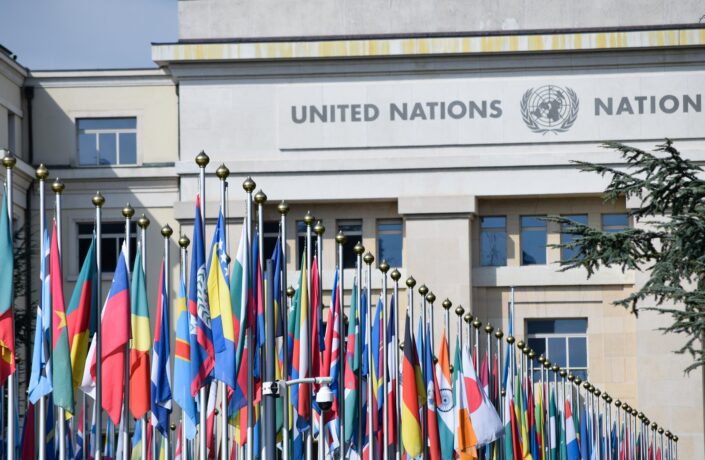
Babu Gogineni: I am struck by the fact that at the events organised by the Norwegian Humanist Association there is always an international presence. And at the Oslo City Hall, Norwegian Humanists were waving UN flags. Could you say something about your international orientation?
Roar Johnsen: International solidarity is an important orientation of NHA. As you know, NHA leaders have played an important role in IHEU as well as in EHF. In 1994 Levi Fragell established HAMU (Humanist Action for Human Rights). HAMU is a part of the NHA, and aims to promote the human rights of the oppressed. It operates by raising funds in Norway and by supporting local secular, non-profit and non-governmental organisations in the global South. It has no employees and all the administration costs are met by the NHA. Currently we support projects in several countries like Uganda, Nepal and India and we have ambitions of growing it into a development agency. We have also been encouraging youngsters to be more involved in international solidarity work through our ‘Freedom Campaign’ and have raised one million Kroner as a result.
Babu Gogineni:What is your own involvement in Humanism, and how do you see your own role in IHEU as one of its vice presidents?
Roar Johnsen: I am not a philosopher. I have been an active member of the Norwegian Humanist Association since 1979, worked on the NHA radio program for six years, served on its national Executive Committee for many years.
At the IHEU, I will look at improving administration, efficiency in use of resources and if that is the decision of the GA, am also looking forward to organizing the 2011 IHEU World Congress in Norway – I was also the organizer of the 1986 IHEU World Humanist Congress at Oslo!