- home
- about IHEU
- human rights
- conferences
- countries
- news
- contact us
World Humanist Congress 1999
Submitted by admin on 14 January, 1999 - 08:14
Iain Middleton, Editor of New Zealand Humanist, reflects on his trip to India to attend the IHEU's World Humanist Congress 10 -1 4 January 1999
India 1999
India, land of smiles and tears, the country where pessimism and optimism meet, the home of religions, rationalism and humanism, a land of many contrasts. A country that travellers often grow to love while others want to leave after just a few hours. A country where some of the world’s most profound optimists see their optimism turn to despair in the face of overwhelming numbers living in poverty. Where some locals can be heard to say that it may already be too late to avoid the consequences of overwhelming population growth, poverty and famine, but where others see in the rising living standards of India’s growing and expanding middle class and expanding economy, an indication of a bright future.
As Babu Gogineni was to tell participants in the 14th IHEU world congress in Mumbai. “Eternal India does not change, it persists. India is a land where we have advanced freedom to previously uncharted territory: ours is the only country where you can drive on which ever side of the road you may please. Where time is not linear but circular!”
Each day the visitor may stop to view new and strange sights. At the Attari Road Border post the Immigration official stops checking passports for half an hour, delaying a tourist bus, while he instructs the painters painting his small building on how to use a paint brush! The waiting visitor may watch a team of women individually adjusting stone chips before pressing them into the freshly tarred road. It is 2:30 in the morning when a plane carrying visitors from Australia and New Zealand arrives at Mumbai International airport. A Wellington mother alights with her 12 year old daughter and a young mother from Sydney proudly holds her new baby in her arms, both pleased to breath the curried air again and planning to catch connecting flights to Delhi to visit their families. The young mother explains that her pharmacist husband said to her “you go, see what has changed and come back”. An hour later, the Wellington mother is berating all the airport staff for their inefficiency (expatriate Indian people are often the most vociferous critics of India), the Sydney mother stands quietly in tears, all their luggage is lost. Despite searches for the missing bags the Wellington woman’s bags mysteriously turn up half an hour later but the young mother must travel on without hers. The computer locates my missing bag in Singapore and it arrives a day later.
A Canadian born Indian woman arrives in tears at the Government tourist office in Delhi, begging the manager to get her out of the country. She had arrived on her first visit to the home of her ancestors just three hours before, full of optimism, but faced with the crowds of persistent touts and hawkers, the often dishonest taxi and rickshaw drivers, the dust, heat, and with face blackened by choking fumes from Mr Piaggio’s oil burning two stroke engines, she did not wish to stay. The proliferation of rickshaws and other motor traffic has made Delhi the world’s 5th most polluted city and Mumbai is not far behind.
On this, my third visit to Mumbai in 20 years, I look for the changes. Boarding the plane in Singapore I wonder where Chennai, the planes first stop, is and assume that it may be a new name for Madras. Gone are the hotel and taxi touts that once crowded visitors arriving at the airport in Mumbai – banned and replaced by a taxi booking system. The streets are more congested, the Maruti Suzuki (Suzuki Alto locally manufactured to Japanese standards) has joined the Ambassador (Morris Oxford) that once dominated the streets with the large Tata (Mercedes) buses and trucks – when increased competition caused car prices to fall in January a TV channel comments that “Maruti Motors put India on the road but Maruti Motors has taken India for a ride.” A local manager proudly shows his Indian designed and built 4 wheel drive vehicle that matches any others on the world market. The motor rickshaws, with Mumbai drivers perhaps more honest than those found in some Indian cities, navigating by horn and ear, are more numerous than ever. Trucks have “HORN PLEASE” written on the back. Some new buildings are evident and construction is underway to build an elevated expressway above the Western Expressway. Indian factories produce goods that vary from those that meet or exceed world standards to the shoddy and cheap for local consumption. The wide gauge suburban railway system shifting millions daily – still one of the most efficient low cost people movers in the world – works on an honesty system reinforced with hefty fines or imprisonment for those found without valid tickets. Churchgate Station daily handles vast numbers and while Victoria Station looks the same it has a new name. Elephants still stop and wait at traffic lights alongside motor vehicles.
Proliferant Bell Boys crowd hotel reception areas while rooms need redecoration. Workers on a hotel construction site can be observed but not working. A deep trench is being dug in the street by a family – the father digs with his only tool, a steel bar, while the children scrape up the soil with their hands and the mother carries it away in a basket. Gone are the signs that carried messages such as “Don’t put alms into outstretched palms” and begging is more evident. A young mother with a baby in her arms begs late at night at the Gateway to India. The shanty areas and hutments, have grown while more people than ever are living in the streets or under blankets strung like tents. Official demolition squads begin to demolish illegal hutments in Andheri East and we wonder where the occupants will sleep, their only shelter destroyed.
Having made it past the hawkers, touts, beggars and rickshaw drivers, the visitor finds the Indian people remain as open, friendly, and welcoming as ever. Conversations with fellow travellers on long distance Indian trains are one of the enduring features of India.
India has made progress, its economy continues to grow at a pace that the West has never achieved but the progress is continually undermined by the population increase. Whenever a new school is built two more are needed. When new well paid jobs are created more young people remain without full employment. When new homes are built more are needed. India’s Nobel prize winning Amartya Sen rates literacy in India at 52% and says 64% of children are malnourished. More than half the children under 12 in 7 cities surveyed have lead poisoning. Open sewers and poor sanitation are common.
Many first time visitors to India attending the IHEU congress in January were shocked by the living conditions that they observed. Paul Kurtz wrote for Free Inquiry, Spring 1999, “It has been two decades since I last visited India, yet I was not prepared for the extent of poverty and squalor and the great number of beggars that we encountered on virtually every street corner and back alley – it has increased enormously since my last visit – and it deeply shocked IHEU delegates from the Western world.” Against this background, Justice Tarkunde chided Western Humanists for spending too much time on internal debates, on philosophy and exposing the fallacies of religion and religious texts, and on countering religious influence. He called on Humanists to become concerned with the problems that are of primary importance to human beings, problems relating to their living conditions. Cities such as Mumbai grow faster than new facilities can be provided.
Those who believe that the free market alone can provide all the answers to the world’s problems should visit India. For here amongst the poor the free market operates without restrictions as everybody struggles to live and eat. Everybody trades and deals or begs to gain the few rupees they need to feed themselves and their families.
The voice of Mother Teresa, often the focus of the Western media but described by the prominent Indian Humanist Abe Solomon as a disaster for India, is no longer able to cry for yet more people to fill the streets so that she could personally score more points on her path to sainthood – providing shelter and prayers for the destitute dying while denying them pain relief or medical help. Millions of dollars donated to her cause were accumulated in bank accounts to be used only for her own world travel, visits to dictators seeking salvation, and her own medical care in her last years.
Unnoticed by the Western Media, the Streehitakarini organisation founded by Dr Indumati Parikh (79) more than 35 years ago, continues its work in the streets of Mumbai, putting Humanism into practice. This organisation seeks to improve the health and wellbeing of women and children in the slums of Mumbai by offering a range of family health programmes, reducing infant mortality and improving life expectancy. Through its efforts infectious diseases have been practically eradicated, 90% of children have received polio and triple vaccines and measles vaccine is given regularly. Mothers are skilled in oral rehydration. Infant mortality has fallen and contraceptive use increased. Contraception is offered and is seen as part of the solution, not as the solution in itself. In addition, the organisation offers many non-formal educational and vocational programs including preventative health and nutrition. Now ably run by people such as Dr’s Taskar and Clapleelcar and Ms’s Jadhar, Shanta Singh, and Shanta Rege the organisation has over 100 women from the area working for it, recruited from among the women of the areas where the work is done. Seventy two percent of couples covered have recognised family planning as desirable and practice it and many women with two children ask for sterilisation. To encourage self reliance most services are charged for at nominal rates, not offered free, but the organisation still requires donations.
In the past the Indian government was committed to birth control – making information and contraceptives, vasectomies, sterilisations, and abortions available. But these programmes driven by demographic objectives that treated women as mere statistics have been largely unsuccessful. India with more than 960 million people may pass China and become the world’s most populous country. Both Muslim and Hindu fundamentalists, fearful that the other group may win the population race, have resisted population policies. Many poor women are still unaware that family size can be regulated and still fear that their children may die young leaving them without support in old age (pensions for old people removes this need but are not available in India). Voluntary sterilisation was once practiced by men but men have largely rejected this since Indira Gandhi’s emergency rule when compulsory sterilisation was introduced.
But there is one Indian state where progress has been made. Kerala, where the philosophy of rationalism has a 3,000 year old history, has long recognised individual well-being as a priority. Life expectancy has risen and is comparable to Western countries. Women are treated equally in education and family sizes have fallen while living standards have raced ahead of the rest of India. Kerala is an example that India could follow. But for the rest of India the descent into universal misery resulting from rapid population growth seems equally as likely. The population time bomb may cause more suffering and death than the nuclear bombs being developed in the region.
With examples like those provided by Dr Parikh and the state of Kerala, the 1994 International Conference on Population and development moved toward a focus on child care and reduction of infant mortality rates and reproductive health with contraception seen as a matter of personal choice for women. Surveys indicate that if women were to have a higher certainty that their children will survive and are given the means to choose the size of their own families, without their husbands dictating the number of children, the world would not have a population growth problem. The previous focus on statistics and contraception alone resulted in resentment by many of the developing countries who felt such programmes were just another neo-colonialist move to exploit and control them. And individuals who felt that with a small number of children they could lose them all and be without support in their old age also resisted.
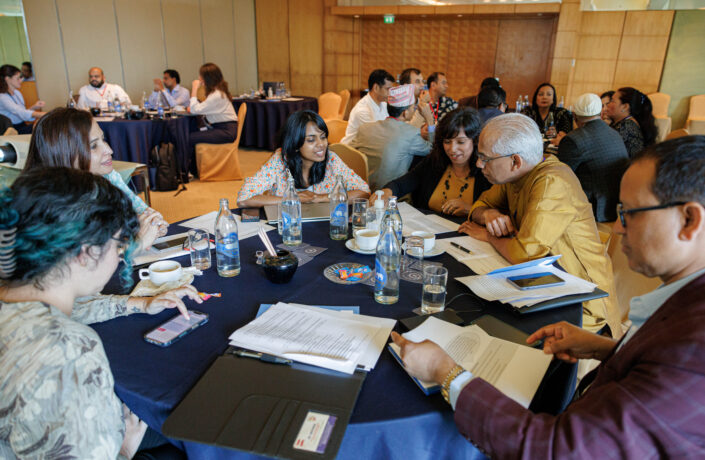
Humanists visiting India for the 14th IHEU World Congress not only benefited from meeting humanists from many countries and from the papers delivered but had a chance to see and perhaps understand a little of India. The congress was held at the partly completed M. N. Roy Centre for Human Development. With the theme of “Humanism for Human Development and Happiness” the Congress was hosted by the Indian Radical Humanist Association, founded by M. N. Roy in the 1940’s, that is dedicated to the progressive improvement of the human condition by democratic means and the use of reason and science. The campus will be the home of the Centre for the Study of Social Change and will provide such activities as a home for the South Asia Humanist Centre that will network South Asian Humanist groups, providing meeting places, seminars, humanist libraries and project work. It will work with Streehitakarini to provide primary health training and care with mobile clinics and vocational training and contraceptive help for marginally educated women. Public libraries, a document centre, toy libraries, art galleries, expression areas, conference and hostel facilities are also planned. The complex will also include cafeterias, a multimedia centre, shopping and banking facilities.
Unfortunately the centre is now under threat from the ruling Hindu Bharatiya Janata Party (BJP) that has attempted to thwart the efforts of local Humanists and repossess the land and building. This centre is deserving of support by Humanists everywhere and an international campaign has been launched by The Council for Secular Humanism with the IHEU and the Indian Radical Humanist Association to complete the next stage of the building so that part of it can be leased, generating revenue to be used in its completion.
IHEU CONGRESS
The 14th IHEU World Congress was held in Mumbai, India, from the 10th to the 14th January 1999. It was attended by some 600 people with about 150 participants coming from countries outside India. The first two days.
The largest foreign group at the Congress was from Norway with 23 participants. Countries represented included from Africa: Nigeria (1) and Uganda (2); from the Americas: Argentina (1), Costa Rica (1), the USA (several) and Canada (1); from Europe: the U.K. (8), the Netherlands, Sweden, France and Germany. Israel was also represented. South Asia was represented by delegates from Bangladesh, Nepal, and Pakistan (1) with the balance of participants being from the many Humanist groups in India. From Australasia four attended from Victoria, and one each from New South Wales and New Zealand.
The longest journeys were those made by delegates from the American Countries (up to 15,000 km) and New Zealand (12,000 kms) but the most arduous were those made by some of the South Asian delegates. Two delegates from Bangladesh spent two and a half days travelling more than 2,000 km overland on a motor bike, while delegates from Nepal spent a similar time making the 1,700 km journey by bus and train.
Mumbai, formerly known as Bombay, the capital of Maharashtra state, is regarded as the financial and industrial hub of India and accounts for half the nation’s foreign trade. It is also the centre of the worlds largest film industry, referred to as “Bollywood”. Built on seven Islands on the Arabian coast, that were originally the home of the Koli fisher folk who still live in Mumbai, the city began to attract migrants after coming under British rule in 1665 and its establishment as a port and trading centre. Early migrants to Mumbai included communities of Parsis and Gujuratis as well as South Indians, some fleeing Portuguese repression in Goa. In recent decades Mumbai has attracted considerable numbers of migrants, mostly from rural Maharashtra. Attracted by the apparent wealth they make the one way trip to the big city – often selling almost all they own in their villages to pay their way they are committed and become trapped through indebtednesses to those who control the hutments (shanty areas consisting of makeshift huts) – unable to return they have helped swell the cities population to 1.5 crore (15 million) resulting in a growth rate that may soon make Mumbai the worlds second largest city.
Statistics for Mumbai are appalling. While many people in Mumbai live a modern and comfortable life style the city features the worlds largest hutments, controlled by local Mafia and plagued by often indifferent, corrupt or religious, chauvinistic, and bigoted politicians. Half the inhabitants of a city unable to cope with the growth rate, have no electricity or running water. A research report on the slum areas prepared by Streehitakarini reported that 26 families may share one water tap and 40 families (more than 200 people) one toilet, yet these same people said that they were satisfied with their lot! Pollution, much of it generated by exhaust from the two stroke motor rickshaws, that clog the streets of the outer suburbs, fills the air – the motor rickshaws are banned in the central city area where traffic flows much more smoothly. Begging, once discouraged, is very evident. People can be seen living in the streets and families in makeshift tents formed by throwing a blanket over a fence or a string tied between a tree and a street pole.
The venue for the Congress was the partially built M. N. Roy Human Development Campus, situated on vacant land next to the Government development complex in the suburb of East Bandra. This Government development “colony” features low cost multi-storey apartments. The main congress venue was in a temporary cloth hall that survived well in the fine, calm and mild (22 to 33 degree) Mumbai Winter.
The Congress opened on Sunday 10th January with the Inaugural Plenary Session, PLENARY SESSION I – INAUGURAL, compered by Dr. Ramesh Potdar. Participants were welcomed with the song “My Song: This is the Song I sing on and off for a while” performed by a student group conducted by Shubhada Ranadive, a family counsellor of Mumbai. V M Tarkunde, president of the Congress Consultative Committee welcomed the participants. Greeting the participants, Levi Fragell, President of the IHEU said that in these days when the harm caused by the tobacco industry causes less dismay than a single cigar in the hands of Bill Clinton, Humanists are and ought to be in the front of Human Rights. He stressed the need for Rationalism and Secularism – as non religion, not anti-religion. He said this was understood by Indian leaders when Europe still had state religion and the US printed “In God We Trust” on its bank notes. In conclusion he stated “Those who don’t believe are those who are normal.”
Babu Gogineni, Executive director of the IHEU, introduced the IHEU and pointed out that 2 of 6 IHEU awards had gone to India, home of more than 20 Humanist and Rationalist organisations. One had been awarded to Justice V. M. Tarkunde for his defence of democracy during Indira Gandhi’s emergency rule. The IHEU supports Humanism in 20 countries and the universal community is more important than nationalism. While stating that the future of Humanism lay in India he referred to India as “unfortunate India” where 15 years ago the BJP was no more than a fringe party, but now, thanks to media coverage, forms the government. He called the IHEU congress a defiant congress, held under the very nose of Bal Thackeray of Maharashtra state – unfortunate Maharashtra – and a challenge to him. Unfortunate that this intolerance should occur in the land of festivals. (Bal Thackeray, a Hindu fundamentalist and leading Maharashtra politician, has stated that he is now the Hitler of the whole of Maharashtra and would like to become Hitler of Indian and rid India of Muslims! During the congress he declared that the damage to the cricket pitch in Delhi was an act of patriotism.)
Dr. Indumati Parikh, president of the Indian Radical Humanist Union and the Congress Consultative Committee remembered M. N. Roy and described his dream of a Humanist Campus now being realised in the M. N. Roy Human Development Campus.
Dr Moegiadi, UNESCO’s representative to India, Nepal, and Sri Lanka, read an address prepared by Dr Federico Mayor who was unable to attend.
Dr Vijayam, Director of the Atheist centre introduced the chief guest, Dr H Narasimhaiah, former Vice Chancellor of Bangalore University, who addressed and inaugurated the congress. Dr H Narasimhaiah described astrology as not only non-science but nonsense as well. “You can not find ten more stupid men than ten astrologers.” Socrates said the unexamined life is not worth living. Referring to Universities he said that mental slums are more dangerous than city slums. “An educated fundamentalist is more dangerous than an uneducated one – education can turn an uneducated fundamentalist into an educated one.” The god man, Sai Baba, had been challenged to prove his miracles but had failed to take up the challenge. Religion says “Believe or be dammed” but has sent the best to hell and the worst to heaven. He said that he believed in Spinoza’s god – the harmony of the universe. The inauguration was completed with the ceremonial planting of a sapling.
Professor Johan Galtung, the Honorary Congress President, was to have released the congress souvenir publication at this stage but was unable to attend due to his plane having struck a bird on take off forcing it to make an emergency landing.
Giving the Keynote address, Professor Amlan Datta pointed out that people all over the globe have an indivisible interest. Since Hiroshima we know that man has in his power the ability to destroy all of human civilisation. He did not have this power in the past. In the next century we will either survive or not. The possibility of an ecological disaster also exists. There are ideologies, such as Nationalism, Marxism, Fascism, etc. In Marxism the conflict of class interest achieved primary attention but it must be viewed none-the-less within the common interest of mankind. A nuclear conflict will not allow one class to survive and another to suffer. It will be a total disaster. The same will be true of an ecological disaster. The Indian continent has some of the poorest nations on the earth yet there is a competition for nuclear weapons. The Socratic spirit was one of Rationalism. We have an allegiance to all of mankind.
Dr M Younis Shaikh of Pakistan read excerpts from some of the replies he received to letters he wrote to world figures informing them of the congress. These included the president of Iran who saw Humanism as an alternative to religion. The president of Pakistan thought Humanism was OK as long as it was Islamic! The Vice-president of the USA said that he would like to be able to attend and the President of the Philippines said he wanted to see Humanism in the Philippines as he was having a lot of trouble with fundamentalists.
The inaugural session concluded with a vote of thanks moved by Dr Gauri Bazaz Malik, Chair of the Indian Renaissance Institute and was followed in the evening by the playing of Humanist Poems, a Marathi/English audio cassette, recorded by Marathi Poet Vinda Karandikar for the IHEU congress.
At the Second Plenary Session, PLENARY SESSION II – THE HUMANIST WORLD VIEW, on Monday 11th, Paul Kurtz of the International Academy of Humanism, gave the key note address “The humanist Way: View from the West” titled “Our Responsibility to Humanity as a Whole”. He outlined trends toward growing world planetary consciousness and globalisation that included instant communication, rapid travel, the global market place, global migrations of people and intermarriage, rising living standards resulting from scientific advances that crossed frontiers, the mastering of artificial evolution, the acceptance of the universal right to education, the global spread of arts and culinary tastes, and the universality of science. He spoke of two possible directions, the first being the encouragement of a pluralistic world split along nationalistic, cultural, ethnic, racial and religious lines but warned of the unfortunate consequences seen with the break up of the former Soviet Union and Yugoslavia. The second option was to transcend the narrow ethnic-cultural chauvinisms of the past and to create a world civilisation in which all sectors of humanity share common values so that humanity could live together in peace and harmony.
He drew attention to and restated the 1988 “Declaration of Interdependence” (see New Zealand Humanist No. 138 June 1998). Speaking of global ethics he called on rational people to express moral caring for the needs of others, to do what is within our power to mitigate the suffering, distress, pain and sorrow of others, to develop a benevolent attitude toward deserving people, and to act so as to increase the sum of human good and happiness – “This means that that we should be concerned with the entire world community” and “include future generations still unborn” and that we should “do nothing to endanger the very survival of future generations” and “use what we need rationally and avoid wasting nonrenewable resources”.
Responding with “The view from the East”, Justice V M Tarkunde, of the Indian Radical Humanist Association and author of the landmark book Radical Humanism, spoke of the current situation in India, a country ostensibly self sufficient in food but where 300 million people live below the poverty line, measured by the failure to get two square meals a day, where 60% of women and 40% of men are illiterate, and where 75 to 80% of people live in general poverty – so the priority for Humanists in India was the alleviation of poverty.
He asserted that people in a democracy get the governments that they deserve. In India, he said, all parties are rotten parties but some are worse than others. So when voting it is necessary to choose the lesser evil. The answer was to help improve the condition of the people so that they can demand better government. The remedy lies with the people. People improve themselves and government. Government does not improve people or itself. The values of individualism, freedom, rationality and self imposed ethics with scientific support from evolution are the individual counterparts of the values of liberty, equality and fraternity – the values of democracy. People must enjoy these values for democracy to exist.
Self-reliance and mutual cooperation must be taught to the masses directly. This must be achieved by Humanists speaking and living with the people who have these needs. Agriculture, water, and education lead to wealth and employment. He reported on visits to four villages where the standard of living had been increased three times in ten years. This was achieved by ensuring that all the girls were educated with only a 10% subsidy from the government – the villages had built their own schools – and controlling population growth. The villagers found out how to manage water and irrigation, reduced unemployment to zero by ensuring that all villagers had useful work and generally achieving self reliance. India, he said, has a great future if only we can stop fundamentalists from imposing a religious dictatorship.
He noted that in England, Humanists tended to keep to themselves and he could not understand why. That in America there are 63 million people who are poor or living in poverty. That in 1982 – 1992 the club of Rome had drawn attention to the exhaustion of world resources. That Indian Humanists did not want India to be part of the atomic powers and suggested that Humanists should press for the elimination of atomic weapons – a useful project for American Humanists. Humanists, he felt, had the worlds best philosophy.
At PLENARY SESSION III – LOOKING BACK: LOOKING AHEAD, Hiranmay Karlekar of the Indian Renaissance Institute, gave a “Humanist Review of our Century”. He disagreed with the proposition that some people are more equal than others and that only some can be trusted with nuclear weapons. All people should work to eliminate them, he said.
Fred Edwords, of the American Humanist Association, speaking on “Humanism in the 21st Century” contrasted 1899 with 1999 and stated that Science and Technology are changing the world more rapidly than religion ever did. He reviewed the advances in biotechnology starting with a patent in 1971, allowed by a 5 to 4 decision of the Supreme court, for a new organism to eat oil. Other dates mentioned included 1983, a super-mouse that grew twice as fast as normal, 1984, the fusing of a sheep and goat, 1980, a $90 million dollar budget for the development of designer biological warfare agents that are quick to develop but for which antidotes might take decades. Seventeen countries have been named as developing biological warfare agents. In a Soviet accident involving an anthrax based agent, three times as many men as women were killed and children were not harmed. In 1988, pigs with human genes were produced.
There are now $500 million worth of sales of human growth hormone produced using biotechnology and prescribed to children in the bottom 3% of height – a practice that changes normality itself. Gene therapy will most often benefit those best able to pay for it. Biotechnology may be employed for cosmetic reasons. We shall see the first artificial human gene. In Australia a pig that is 30% more efficient has been produced and it can be marketed 7 weeks earlier. Animals are becoming laboratories or pharmacies producing drugs and hormones that we need. Various mammal clones have been produced leading the way to the mass production of customised animals and artificial or cloned organs.
“Just as we are coming to understand evolution we are gaining the power to change evolution”. Acknowledging that there are reasons for caution but not to abolish these new sciences he stressed that no mater what religion preaches we must deal with the changes. Biotechnology, already of benefit to mankind, may be of greater benefit to humanity and the world in the future. “Humanism of all the philosophies is the best prepared for the future”.
On Monday afternoon there were four parallel sessions. They were:
A. Social Development and Humanist Values: Inspirations from the Field - HIVOS
B. Fundamentalism and Islam
C. Integrated Human Development
D. Humanism Organised.
On Monday evening a play Lokkatha ‘78 (Folktale ‘78) in Marathi, the state language of Maharashtra, was presented by local players. It depicted the oppression, rapes, bloodshed, murder and police corruption that are still features of village life in India.
LAST THREE DAYS OF THE CONGRESS
The congress continued with the majority of the delegates now able to find the venue without getting lost and accustomed to the local timekeeping.
Tuesday began with reports from the parallel sessions of the previous day followed by PLENARY IV –CHALLENGES TO THE GLOBAL COMMUNITY Chaired by Hans Hoekzema.
The first speaker, Kumar Ketkar, Editor of the Maharashtra Times, spoke about “The Arms Race and Atom Bombs”. The Maharashtra Times was the only paper in the state of Maharashtra to oppose the Indian atomic explosions. During an atmosphere of intolerance and violence there were marches and public burnings of the paper. The BJP, whom he thought would lose the next election, saw the tests as part of the growing strength of India and an honour to science but he saw them as examples of extreme nationalism.
He talked about the part played by the Brahmans in this extreme Hindu nationalism. These people, he said, are vegetarians, they don’t own land and are not involved in industry. They are knowledge based, they had thought that they could control the politicians and thought that all Brahmans should unite to achieve this end but they have progressively lost power since independence.
He considered that there has been an alarming growth of the middle class in India, now numbering 250 million. These people are non productive white collar workers who are facing a new threat to their power from the producing classes. The two are fighting one another and ignoring others – killing Mahatma Gandhi.
It is the traditional middle class group who seek to maintain their power and prestige through the development of nuclear arms. But as more people enter the middle class from the peasant and working class there is a need for integration and tolerance.
Professor Satyaranjan Sathe chaired PLENARY V – KEEPING RELIGIONS AND STATES APART.
Carl-Johan Kleberg spoke on the “Separation of Church and State in Sweden”. The church in Sweden was previously ruled by a large book of laws. The State collects a church tax and 20,000 personnel are paid from this tax. People were not permitted to leave the church before the 50’s. After thirty years of reports and investigations the last Bill to alter the law was introduced a few weeks ago. A change to the economy is feared.
A Summary of the changes follows: 1. Legislation will be changed but the role of the church will be defined. 2. All existing church property will be given to the church. 3. The church will get a lot of money to preserve cultural union. 4. The church tax becomes a fee. $250 pa per person. 5. The church will be given the main responsibility for funerals and a special new tax raised. 6. The king and his family will be obliged to be a member of the church.
Humanists have responded as follows: 1. At present two municipalities have responsibility for funerals – we think this should be made general. 2. The Royal family should be entitled to freedom of religion. 3. We must convince people – 82% of people are members of a church but only 55% of people believe in god. 4. We work very hard to develop secular ceremonies and we contribute to a book that is an alternative to the church hymn book. We are hoping for some support from Norway.
N. D. Pancholi, a journalist and human rights activist spoke on “Religious Separatism & Terrorism in Kashmir.” He said that the movement for separation in the Kashmir valley is not a religious movement. The main cause of the movement is that the people of the valley feel that they stand deprived of their democratic need to govern themselves in accordance with their own desires. Despite claims by Indian leaders that the state of Jammu and Kashmir is an integral part of India it remains a baffling problem – a reflection of the dilemma faced by modern democracies as to how different social and cultural orders can remain as one political unit and born out of the partition of the Indian sub-continent into India and Pakistan in August 1947.
At independence, Pakistan was formed out of Muslim majority areas – for instance the majority of the Punjab elected to go to Pakistan. The Hindu Prince of Jammu and Kashmir, that had a Muslim majority, initially refused to nominate his intention. In October 1947 Pakistan encouraged and abetted warlike tribesmen from the Northwest Frontier to invade the state and force it to join Pakistan. The prince immediately signed a conditional Instrument of Accession with India and in the same month Indian forces halted the advance but the raiders had already captured a substantial area of Jammu and Kashmir resulting in the present partition of the area. In August 1948 the Security council suggested a Plebiscite to decide if Jammu and Kashmir should be acceded to India or Pakistan but India has asked for a withdrawal of Pakistani forces first.
“The culture and traditions of Kashmir were more on the side of tolerance and secularism than on communalism.” A dynamic philosophy called ‘Religious Humanism’ was founded in the 14h century by a Hindu Brahman woman called Lal Ded and supported by Nand Rishi a Muslim. Respected by both Hindus and Muslims they taught love of all human beings irrespective of birth, caste or sex and the equality of men and women. This very influential philosophy moulded Kashmiris, both Hindu and Muslim, into a peace loving and tolerant people. When communal violence erupted throughout India with the formation of Pakistan, Kashmir remained peaceful.
The Indian constitution, framed in 1950, was built on a firm foundation of secular principles with no trace of religious bias and gave its citizens equality of status and opportunity irrespective of caste and creed. Kashmir was granted special status and virtual autonomy under article 370 of the constitution – the central government was empowered to handle only External Affairs, Defence and Communication. But Sheikh Abdullah and his party the National Conference, that formed an autocratic Kashmir government, during their first seven years of rule arrested thousands of political opponents, labelled them as Pakistani agents, even when they were secular and pro-Indian, and jailed them. Almost every election held in Kashmir has been rigged. In 1951 the ruling party captured 70% of the seats uncontested – mostly by cancelling opposition nomination papers on flimsy and frivolous grounds. By similar means it captured 41 out of 45 seats in 1957 and 40 of 45 seats in 1962. In 1967, 226 nominations were filed, 118 were rejected enabling 21 ruling National Congress party nominees to be elected unopposed.
Although the Indian military is in Kashmir to defend against external threats the military is used by the party in power to suppress the opposition. Every year the number of military has increased and the central government has restricted Kashmiri leaders to those pliable to it.
The blame for the unrest is placed on Pakistan but in fact it is due to the shortcomings of the central government. Kashmir is a problem of India’s own creation. This situation generated frustration, resentment and dissatisfaction amongst the Kashmiris and in 1989 young men began to resort to terrorism.
The cruel and inhuman behaviour of the Indian army is adding to the frustration. Indian security personnel do not regard the local Muslim population as citizens of India. Unspeakable indignities are hurled upon Kashmiris. People are detained on mere suspicion, tortured, maimed and often killed without following any legal procedure. When people are detained their family is not informed and bodies are delivered to the house with no details known. Allegations of rapes of Muslim Kashmiri women by security men are not uncommon.
The terrorists are certainly guilty of violations of human rights by indulging in killings and massacres of those who are suspect in their eyes. The human rights organisations have unequivocally condemned this kind of terrorism. The terrorists are if fact harming the cause of the people because their activities give excuse to the government to adopt more repressive measures. In 1989-90 there was a mass exodus of Hindu Pandits from the valley promoted by the then Governor of the state. The terrorists have in fact killed more Muslims than Hindus.
The terrorism has also led to increased corruption. Lots of security people request transfer to Kashmir – the reason is big money – people are bribed to allow the importation of arms and ammunition over the borders into the state for the terrorists. But this is not allowed to be reported publicly for security reasons – it is claimed to be part of general corruption.
There have been periods of increased terrorism in the valley but my reading of the situation is that the majority of people in Kashmir neither want India nor Pakistan – they want to be free – while the people of Jammu, Ladakh and Doda have their own grievances that are mainly directed against the politicians of the valley who have dominated the states politics for so long. The Kashmir issue is a very complex problem.
“In the beginning the Kashmir movement was secular and democratic. But of late, repeated attempts have been made to communalise it. If steps are not taken to solve it, it will be a great loss for democracy and humanism. Kashmir has a very rich tradition of secular humanism. It should be the concern of Humanists the world over to help Kashmir in preserving it.” The Humanist tradition of Kashmiri culture must be preserved.
After this paper Dr. Gauri Bazaz Malik commented. “I am myself a Kashmiri. At separation, 72% of the population of Jammu and Kashmir was Hindu, not the greater than 50% Muslim as stated.”
B. Premanand, convenor of the Indian Committee for the Scientific Investigation of Claims of the Paranormal (Indian CSICOP), spoke on “The Nexus between ‘god-men’, politicians and the Judiciary”. He described how politicians and the Judiciary had supported the ‘God Men’ of India and how he had challenged these ‘God Men’ and in some cases discredited them. He told of a man who claimed to have gone without food and water for 50 years. “I wrote to the press council and said I only needed 5 minutes with 3 doctors and three tubes to prove him wrong. He refused the challenge and his followers lost faith in him. Two years later he was murdered – presumably by his own followers.”
The most renowned of the ‘God Men’ is Sathya Sai Baba of Puttaparthi in Andhra Pradesh. A video cassette was obtained where he created a diamond necklace from nowhere. On the video his assistant was clearly seen handing him the necklace. Three copies of the cassette were made. In an ensuing court case no witnesses were called and Sai Baba was not produced but the case was dismissed.
The Judiciary, but not necessarily the Judges, are the most corrupt department in India – to get anything done you must bribe, bribe, bribe. Six murders occurred in Sai Baba’s bedroom – false information was published in the newspapers yet the Chief Minister of Andhra Pradesh closed the case!
On Tuesday afternoon the Congress divided into five PARALLEL SESSIONS. The topics covered were:
E) Combating Superstitions.
F) How are we to Live? Humanism for the Personal life.
G) Campaigning for Humanism – The Programme Ahead.
H) Humanism in the Sub Continent.
I) Open Session.
PLENARY VI – WORKING TOGETHER FOR CHANGE, Greetings from Kindred Organisations, completed the days formal activities. An Indian dance group provided the evenings entertainment.
On Wednesday, Justice V. M. Tarkunde chaired PLENARY VII – DEMOCRACY AND HUMANISM.
Dr Jai Prakash Narayan of Hyderabad and Campaign Coordinator and founder of the Lok Satta Campaign, a popular movement in
Trackback URL for this post:
http://www.iheu.org/trackback/202
»
- Login or register to post comments
-

- Printer-friendly version