Defending the 1905 French Law of Separation of Religion and State
The 16th World Humanist Congress was held in Paris in July 2005 on the theme of Separation of Religion and State. Commemorating the centenary of the 1905 French law which established such a separation, the World Congress passed an important declaration which has been published in the International Humanist News of August 2005. The 1905 law establishes laicité, or the institutional Separation of Church and State, a defining characteristic of the French republic. Of seminal importance in the ongoing and permanent battle for the freedom of conscience, Laicité is under attack today. Roger Lepeix writes of the dangers, and of the spectacular efforts by French Freethinkers to save a valuable institutional arrangement.
A Seminal Achievement
By separating religion and ideologies from the state, the French legislator of 1905 established equal rights for all, thus erecting one of the pillars of the French Republic. The complete absence of links between state and religion or state and ideology is one of the essential conditions for the freedom of conscience. With this clear separation, all citizens have the same rights independent of their affiliation to a church, association, life stance or political party. In its centenary year, however, this seminal institutional achievement is facing serious attacks.
The European Union
Separation of Religion and State is under attack from the European Union and its supporters who, in the name of harmonisation of the law with countries where this separation does not exist, would like to do away with it. The 1905 law is often presented as a French oddity or as a result of historical forces and a product of the French political climate of 1905.
It is wrong to make this claim of course: the issues this law covers are of universal significance and it is only the drafting of the legislation that is linked to a moment in history and to a particular nation. From an institutional point of view, the proposed draft Constitution for Europe, luckily rejected by French and Dutch citizens, would have signed the death warrant for the Fench law of 1905. This is because the 1905 law would have been subordinated to the European Constitution which intends to introduce representatives of religion into the official decision making structures of Europe.
A temporary reprieve has been obtained with the defeat of the constitutional project, but there should be no doubt in our minds that the clerical forces will rapidly jump back to the assault.
Peddlers of Soft Laicité
Separation of Religion and State is under attack from those who proclaim openly a laicité ouverte or 'soft laicité' or 'constructive laicité', where religions would again find a place in the public space. Those who advocate this would like us to believe that separation exists because concordats are being signed - since a concordat assumes independent partners signing an agreement. For the defenders of laicité, however, the proof of Separation of Religion (usually the Catholic Church) and the State is not the presence of a concordat, but rather its absence!
These same people, along with some others, also ask for equal rights for all churches and religions. However, they hide the fact that in the first place the 1905 law does not give any rights to any religion, simply because it does not recognise them! The Republic recognises only citizens and not communities, either religious or ethnic or others.
Islam
Separation of Religion and State is also under attack from those who wish to use Islam as a tool in the battle against the 1905 law by claiming that this religion did not exist - or hardly existed - in France at the time this law was promulgated. By saying this, they intend that the presence of Islam in France now necessitates a re-evaluation of the law. Using Islam as a tool in the argument is very often a tactic employed by the Catholic Church for achieving its own ends. In any case, apart from the fact that this is an incorrect claim (Muslim-majority Algeria became independent only in 1963 and was therefore a part of France when this law was formulated), this argument is also irrelevant. The fact is that the 1905 law has two aspects: firstly it separates what was united until then (and many of its articles are drafted in this direction), and secondly it installs a new system of institutional separation between the State and Religion, whether old or new.
Finally, Separation of Religion and State is also under attack from some politicians, be they from the 'right' or from the 'left'. In particular, the current French Interior Minister plays an active role in raising doubts about the 1905 law.
The Public School One must add that the Separation of Religion and the Public School, which is also intended by the Separation of Religion and State, as well as by other laws and legislative texts, is equally under attack from different quarters. This Separation is one of the conditions for the proper functioning of the Public School - which, shielded from the pressures of society and forces of obscuranism, is expected to to transmit to future citizens the knowledge and the methods of thinking and working which will enable them to defend the achievements of the Republic, and where necessary, to take them forward. This conception of Separation is opposed to the current efforts to introduce religion into Public Schools in the name of 'facts of religion'.
Based on the supposed claim that religions are social regulators, the European Charter of Human Rights also includes expressions relating to religion.
Historically
It is appropriate in this context to point out that the Law of Separation of Religion and State of 1905 has been compromised over time
- by the refusal by governments to extend its application to three departments (referred to as Alsace-Moselle), which were part of Germany in 1905 and became part of France after the war of 1914-1918.
- by Marshall Pétain and by the Vichy regime during the German occupation (1940-1944). They introduced damaging modifications to the 1905 law in 1941 and 1942, and no government since then has reconsidered these modifications.
- through adoption of a number of anti-secular laws which, hostile to the concept of Separation, gave astronomical sums of public funds to private confessional schools, mostly Catholic.
Fighting Back
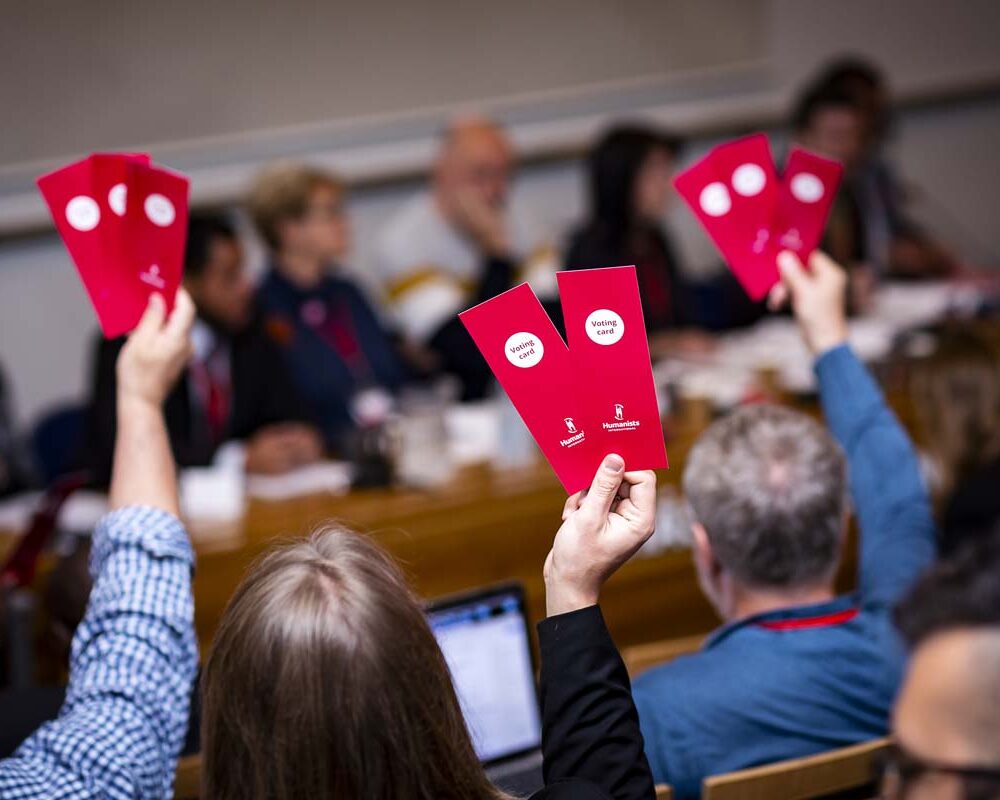
In the face of these threats, and with the aim of defending laicité by putting back the 1905 law at the center of its defense and restoration, 50 nationally known personalities (amongst whom leaders of the Libre Pensée Franà§aise) took the initiative in 2004 to organise a huge rally on 10 December 2005, to mark the 100th anniversary of the law.
They put forward the following demands:
Restore the 1905 Law!
Abolish the clerical status for Alsace-Moselle!
Respect the principle "Public Funds only to the Public School!"
Abolish all anti-secular laws!
For a laicité without restrictions!
Great Success!
The proposal for a national demonstration received support from 3000 other personalities, 48 associations (amongst which the Libre Pensée Franà§aise), by over a 100 elected representatives in the republic and by 70 international personalities. The Executive Committee of the IHEU decided in September 2004 to support the demonstration and delegated Roy Brown and Babu Gogineni as representatives.
This demonstration took place as planned, and what a great success it was!
The 100 years of the 1905 law were celebrated in a dignified manner by over 12,000 demonstrators. It took the demonstrators over two hours to march between the Place de la Republique and Place Richelieu-Drouot.
Without support from the media, without any public funds (unlike for religious demonstrations!), without any help from the big parties, without help from the government or from its ministers, the secular strength of the nation was on display on this December afternoon in Paris.
Led by the 50 first signatories of the Appeal to Laicité who had taken the initiative to call for the public demonstration, the procession was led by Marc Blondel, the freethinker and trade union leader. Then came 2000 Freemasons, mainly from the Grand Orient de France, all draped in their well known French colours.
Associations like the Union des Athées, le Comité-Laïcité-République, le Mouvement Europe et Laïcité (CAEDEL), l'Union Rationaliste, l'Association du Chevalier de la Barre of Abbeville and of Paris, Laicité-Liberté, the Esperantist and others followed them.
International Presence and Support
The international section was behind the banner of the International Humanist and Ethical Union. Shoulder to shoulder, the Luxembourgeois, the Belgians, the Italians, the English, the Spanish and the Portugese relayed the slogans "From Moscow to Lisbon, London to Washington: We demand Separation of Religion and State"
Messages of support and solidarity had come in from the US, Ireland, Argentina, the Czech Republic and from New Zealand in the hours before the demonstration. The Humanist and Rationalist Association of Auckland, New Zealand, wrote "There could be no better place than the Place de la Republique for such a demonstration, because it is in the ideals of the Republique that the principle of Separation of Religion and State was born. We wish you all success in your battle to defend the 1905 law".
The Libre Pensée was next in line. All the federal departments were represented - 120 came from Pas-de-Calais, 150 from the Bouches-du-Rhone - they were there from all over the country - from l'Ain to the Val d'Oise. A sea of red and black flags, and a multitude of banners, some of which over a hundred years old, added life and colour to the demonstration.
With 3000 Freethinkers from the provinces and 2000 from the Paris region, this was the biggest contingent. They chanted slogans demanding that anti-secular laws be abolished, and insisted that public funds be allocated only to Public Schools. They demanded the abrogation of the clerical status for Alsace Moselle and called for the defence of the 1905 law.
At the end of the demonstration, Marc Blondel, trade unionist and freethinker spoke: "It is laicité which is the guaranty of equality amongst citizens. Laicité is the refusal to accord privileges, be it a privilege because of religion, or because of birth. It is laicité which creates the feeling of fraternity which is necessary for the establishment of solidarity. It is laicité which liberates the individual from all forms of submission, and therefore becomes the harbinger of Freedom.
Jean-Michel Quillardet, the Grand Maà®tre of the Grand Orient de France recalled the committment of all Freemasons for the Republic and for laicité. Addressing the government, he said that the Grand Orient de France wanted the application of the 1905 law - all the law, nothing but the law and nothing less than the law.
Babu Gogineni, Executive Director of IHEU proclaimed that laicité was not a French exception, but that laicité belonged to the universal heritage of human kind. There could be no democracy without separation of religion and state. This applies to all continents and to all countries (see box).
Christian Eyschen
Christian Eyschen, Secretary General of the Libre Pensee ended the meeting with some eloquent words: "It is important that governments and ministers understand this self evident matter: Laicité lives in the conscience and minds of millions of citizens of this country. To tamper with it is to tamper with democracy and indeed with the Republic itself.
"Paris, the city where we are meeting is where the Separation of Religion and State has been voted on three times. It is at Paris that in 1795 under the Convention, in 1871 under the Commune, and in 1905 under the Republic, our elders broke the alliance between the throne and the other world, between the state and political ideology, between the state and religion.
"It is our elders, Emiles Combes, Ferdinand Bousson, Aristide Briand, Jean Jaures, Frederic Desmons, Georges Clemenceau - all of them Freethinkers - who fought for democracy by instituting the complete and total freedom of conscience. It is our Freethinkers, the Freethinkers of today, inspired by the glorious work of our elders, who have worked incessantly for the last 14 months to make this secular demonstration a success. We can say it with pride: today, once again, we have brought together what was dispersed in the nation, to make an indissoluble force for the Republic, for Democracy, for Liberty, for Equality, for Fraternity and for laicité.
"It is in their name, as Secretary General of the Libre Pensée, and as repository of its mandate which is over 150 years old, that I wish to thank all the Freethinkers, trade unionists, labour activists, true republicans and the Freemasons who have, together, made this demonstration in support of laicité such a success.
"We have worked together to ensure that the Centenary of the 1905 law will enter into the pages of history. Today, together, we have written a page of history which will not be forgotten.
"But this secular battle will not be our last. Laicité is always endangered in our country. It is under threat from governments which are subverting it, from ministers who wish to destroy it, from the churches which are pilfering public funds.
"The Public School is being robbed of billions of Euros of public funds to finance private schools which are essentially catholic. There are always ministers - yesterday Jack Lang, today Gilles de Robien - who receive papal indulgences at the cost of public funds which belong to the citizens of this country.
"There is a minister of Interior, or should I say, the 'sinister' of Interior, who has just created a commission to 'clean up' the 1905 law and to adapt it to the clerical demands of the European Union. This commission is to give its report within 6 months with its proposals to further dismantle the institutional secularism of our country. Basing itself on the anti-secular laws of the Vichy Regime (which have never been abrogated since), the president of this commission intends to continue the process of destruction of the 1905 law.
"We will not let them get away with it! They will not succeed! They will not be allowed to continue! We will embark on the mobilisation of secular people to defend secularism. 2006 will mark the centenary of the inventory created by the 1905 law, and an inventory we shall prepare.
"Working with all those who wish to continue our common initiatives, we propose to create a commission of inquiry on the violation of laicité. In communes, in departements, in the regions, in the administration: let us, together, make an inventory of public funds hijacked for religion.
"Mr. Sarkozy has given us an appointment in 6 months. Now it is our turn to give him one. In June the creators of the secular inventory will converge at the Estates General of laicité where we will inform the public of this country of the true state of affairs, about the rape of democracy, about the attacks on laicité and about the funds hijacked.
"And together, we will decide the common action to be taken to defend, restore and to promote laicité in the Public School and in the State. Together, we will continue to struggle. And of course, the old refrain of the Freethinkers - fighters for the emancipation of Humanity - will continue.
"Ni dieu, ni maà®tre! A bas la Calotte! Et vive la Sociale!"
Roger Lepeix
Translation by Babu Gogineni