Fighting Anti-Science in the New Russia

 Russia
Fighting Anti-Science in the New Russia<?xml:namespace prefix = o ns = "urn:schemas-microsoft-com:office:office" />


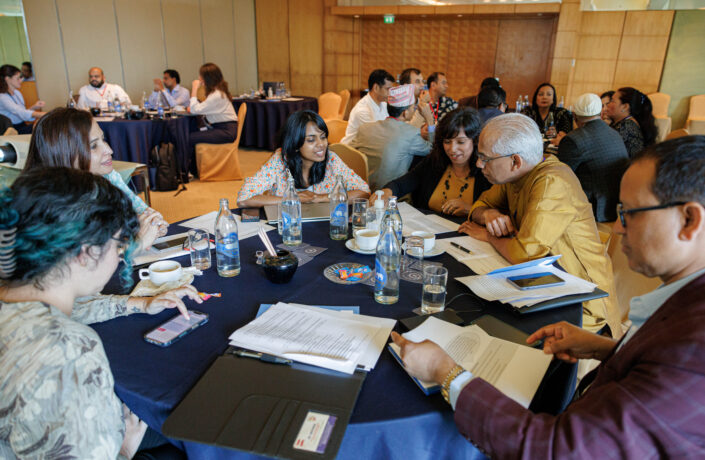
Thinking, or more accurately, critical thinking, was the underlying theme of a conference on Science, Pseudo-science and Anti-science held in Moscow from 3rd to 6th October 2001. The conference was held at the Russian Academy of Sciences, joint sponsors of the event with the Department of Philosophy, Moscow State University, IHEU’s Russian member organisation the Russian Humanist Society, and the Council for the Scientific Investigation of Claims of the Paranormal (CSICOP) which is a cooperating member organisation of the IHEU.


Spiritual Vacuum

Since the fall of communism things have not gone well for science or rational thinking in Russia. The collapse of communism created not only a political and economic vacuum but a spiritual vacuum as well Ð and one that the Orthodox Church has been quick to fill. Hundreds of old churches have been restored, church buildings confiscated by the state over half a century ago have been handed back, and new churches seem to be springing up on every street corner. 90% of the population now profess a belief in God, a figure not dissimilar to that for the United States, although only 10% of Russians attend church regularly.


The spiritual vacuum has also been a rich feeding ground for every kind of pseudo-science, New Age cult and the newer religions from Jehovah’s Witnesses and the Mormons to Scientology.


An October Conference

The October conference signalled the beginning of the fight-back by science and rationalism. It attracted many of the most active and popular Russian critics of anti-science and paranormal beliefs. Academician Edward Kruglyakov (Chairman of the Russian Academy of Sciences Committee against False Science and Falsification Of Scientific Data) said that pseudoscience is becoming dangerous for both science and society. The past 10 years have seen the appearance of about 120 “academies”, most of them self-proclaimed pseudo-scientific organisations. They openly attack science, insisting that scientific paradigm is withering hopelessly away. Organised false science has well established connections with the high bureaucracy in Russia and with certain secret military institutions, which help it avoid independent scrutiny. Kruglyakov gave a number of examples showing how presidential, governmental and parliamentary structures give organised charlatans access to funds from the national budget.


Academician Garry Abelev (of the Russian Academy of Sciences and a world authority on the immunochemistry of cancer) focused on the differences between the false science and mistakes in scientific research. He also stressed that the greatest danger for science is the expansion of ideology and popular beliefs into science. False science begins when ideology, power, illegal money, and public ignorance start to interfere in the scientific enterprise.


The positive role that science has played in cultural progress was the theme of Professor Yuri Efremov (an astronomer from Moscow State University and the leading Russian opponent of astrology) who also showed the reactionary intentions of the proponents of false science, religious fundamentalism and postmodernism.


Professor David Dubrovskii (Institute of Philosophy of Russian Academy of Sciences, and a pioneer of the scientific investigation in Russia of claims of the paranormal), analysed the sources of the paranormal beliefs, two being the insufficiency and uncertainty of empirical data.

Revival of interest in religion in Russia

Prof Sergey Kapitsa is a popular TV showman and for many years ran the most popular scientific program on T.V. He argued that anti-science in Russia is so powerful that it is time to talk about a new kind of organised crime. If unchecked, it will lead inevitably to a new barbarism and to the disintegration of culture.


In his talk on Science and Humanism, Valerii Kuvakin pointed out that the danger is rather greater for society than for science itself. A scientific worldview is not enough to resist charlatanism and irrationalism. We need a unity of basic human values. Modern Humanism provides a free and open platform for the alliance of science and reason with moral and civil values.


One highly visible participant at the conference was an Orthodox priest, magnificent in his black robes and huge gold cross, looking, he said, for common ground with the scientific community in the struggle against paranormal nonsense. Unfortunately, he turned out to be a Creationist. One presenter whose blatantly pseudo-scientific subject was “the continuum between the material world and the spiritual” jerked me awake when he used the phrase “knowledge beyond science”. A member of the audience bluntly suggested that he was at the wrong conference. “Oh no!” he replied, “I was invited by the organising committee.” His institute is state-funded.


Moscow

Moscow itself is now a bustling western-style city. In marked contrast to the recent past, you now enter Red Square to the sounds of church bells and a heavenly Russian choir emanating from a near-by church. The entire left hand side of the square is still occupied by the baroque magnificence of GUM, but now housing the top western designer boutiques and elegant even by the standards of Fifth Avenue. Facing you is the baroque masterpiece of St BasilÕs, like so many churches, currently undergoing a major restoration. To the right the massive red brick walls of the Kremlin with, at its centre, the dark marble of LeninÕs tomb. Lenin is now more distant in history it seems than Catherine the Great. The Communist Party is still supported by 30% of the electorate but is hardly the Communist Party of old. The new communists are falling over themselves to find favour with the church, their leaders missing no opportunity to confess their newly-found faith in the church of Mother Russia.


In such a climate it is hardly surprising that every kind of pseudo- science and New Age nonsense is flourishing. Books on Creationism, UFOlogy, clairvoyance and spiritualism are best-sellers. What can Rationalists and Humanists do in the face of such a massive lurch to the transcendental? At the conference, at least, the objectives were clear: to oppose any further encroachment of religious dogma into education; to defend the secular constitution and the separation of church and state; to encourage the teaching of critical thinking; and to build as rapidly as possible a network of Skeptics, Rationalists and Humanists able to take on the claims of the transcendentalists wherever possible in this vast country.


A Milestone

The conference will almost certainly prove to have been a milestone in the fight back by rationalism in Russia. Among the foreign visitors were a number of the world’s leading Skeptics and Humanists including Prof Paul Kurtz, founder and chairman of CSICOP, Joe Nickel, senior researcher at CSICOP, Prof Lee Nisbett, Prof James Alcock, Ms Jan Eisler, a vice-President of IHEU, and Amardeo Sarma, president of the European Skeptics. All gave stimulating presentations that were not only highly entertaining but full of advice and good sense about how to approach the pseudo-scientific claims that surround us.


Better teaching of science is a priority, with an emphasis on science as a process of observation and discovery rather than the acquisition of a set of facts. Also needed is a recognition that critical thinking and free inquiry are not limited to the hard sciences but are needed in the social sciences, economics and politics as well.


Russia lacks any tradition of critical examination. The feudal system of the Tsars was replaced by the totalitarian Soviet state and there is no doubt that many Russians yearn for the comfort of a new authoritarianism in which the church would play a key role. But if religion is to be taught in schools it must be taught as part of Russian history and culture, not as fact.


The Russian Humanist Society is now established as a national organisation. They have five branches and about 300 members and are keen to open further branches in every major city where support can be found. They have just published the 22nd issue of Common Sense, their authoritative and well-respected magazine, and have translated and published a number of key works, including Paul Kurtz The Transcendental Temptation and The Courage to Become. The RHS lobby politicians on key social issues. They are currently hoping to raise the few thousand dollars they need to buy some office space in Moscow rather than being forced to work as now either from home or from an office shared with other staff at the University.


As the only apparent opposition both to the spread of every kind of New Age nonsense in Russia and to the growing influence of the church, they deserve our support.


If you would like to support the work of the Russian Humanist Society in however small a way, please email Prof Valerii Kuvakin at:


Roy Brown is a Vice President of the IHEU, and Chair of the

IHEU’s Growth and Development Committee