IHEU's Bylaws
BY-LAWS (equivalent to Statutes or Constitution in some jurisdictions)
Also available in French Aussi disponible en Francais 
As amended by the General Assembly on 27-28 May 2004, Kampala, Uganda
1. Main purpose
To bring into active association groups and individuals throughout the world interested in promoting humanism, understood as dedication to and responsibility for human life by maintenance, furtherance and development of human values, cultivation of science, loyalty to democratic principles and repudiation of authoritarian principles in all social relations, and practice of good faith, without reliance upon authority or dogma.
2. Membership
2.1 Membership of the International Humanist and Ethical Union (IHEU) is open to humanist and ethical organisations worldwide.
2.2 Membership of organisations, or a change in status of membership, is granted by the General Assembly under terms laid down by these By-laws (section 5). Proposals must come via the Executive Committee. There are the following categories of membership:
-a) Full members: membership organizations whose purpose is consistent with By-law one. Control should be democratic.-b) Specialist members: organizations whose purpose is the promotion of specialised activities which are consistent with By-law one.-c) Associate members: organizations whose purpose is consistent with By-law 1 but who do not wish to have a vote at the General Assembly.
2.3 Individuals may become a supporter of the IHEU. The Executive Committee will accept or refuse any application to become an annual or life supporter on payment of the relevant fee.
3. General Assembly
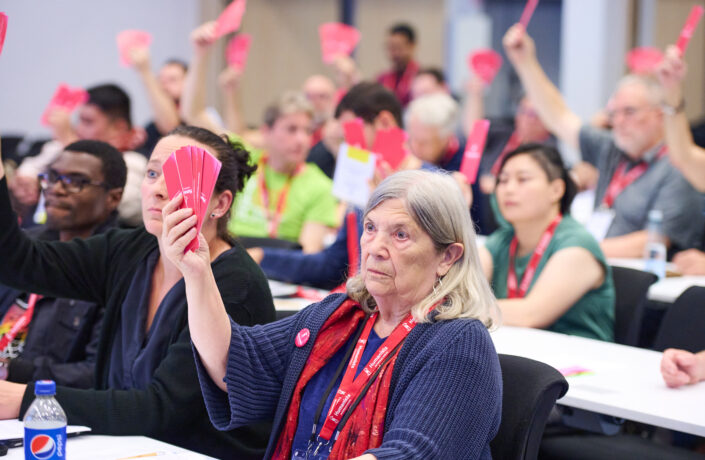
3.1The IHEU General Assembly shall be made up of members of the Executive Committee and representatives of member organizations and sections.
3.2 The General Assembly shall be the policy making and controlling body of the IHEU and its business shall be carried out in the IHEU’s official language which is English. Its business may be transacted by correspondence.
3.3 The Executive Committee shall call an annual General Assembly each calendar year, and shall specify the meeting as such in the notices calling it.
3.4 A special General Assembly may be called by the Executive Committee, and shall be called at the request of members holding one third of the General Assembly votes providing they come from at least three countries, and shall be held in the country where the IHEU office is situated.
3.5 At least 120 days notice of the General Assembly shall be given to all member organizations and individual supporters (subject to para 3.6). Member organizations may submit items for discussion or resolutions to the IHEU office, to be received 60 days before the date of the General Assembly. The agenda together with all relevant papers shall be sent to member organisations, any representatives who have been identified and any individual supporters who have indicated their attendance, at least 30 days before the date of the General Assembly.
3.6 An emergency General Assembly may be called at shorter notice either by the Executive Committee or on receipt of a request members holding one third of the General Assembly votes providing they come from at least three countries. The notice of such a meeting must contain an explanation of the emergency and the proposed agenda and resolutions for the meeting and shall be held in the country where the IHEU office is situated.
3.7 The General Assembly shall be chaired by an Executive Committee member or a voting member elected by the General Assembly.
3.8 Full members shall be entitled to a number of votes at the General Assembly determined by the following formulae with the result being rounded up to the next whole number: 
*NUMBER OF MEMBERS = the total individual voting membership of the organisation, which must not exceed the number taken into account in calculating the IHEU dues.
*Full members who have negotiated a restricted membership due under paragraph 5.4.4 shall have only one vote.
3.9 Specialist members shall be entitled to one vote at the General Assembly.
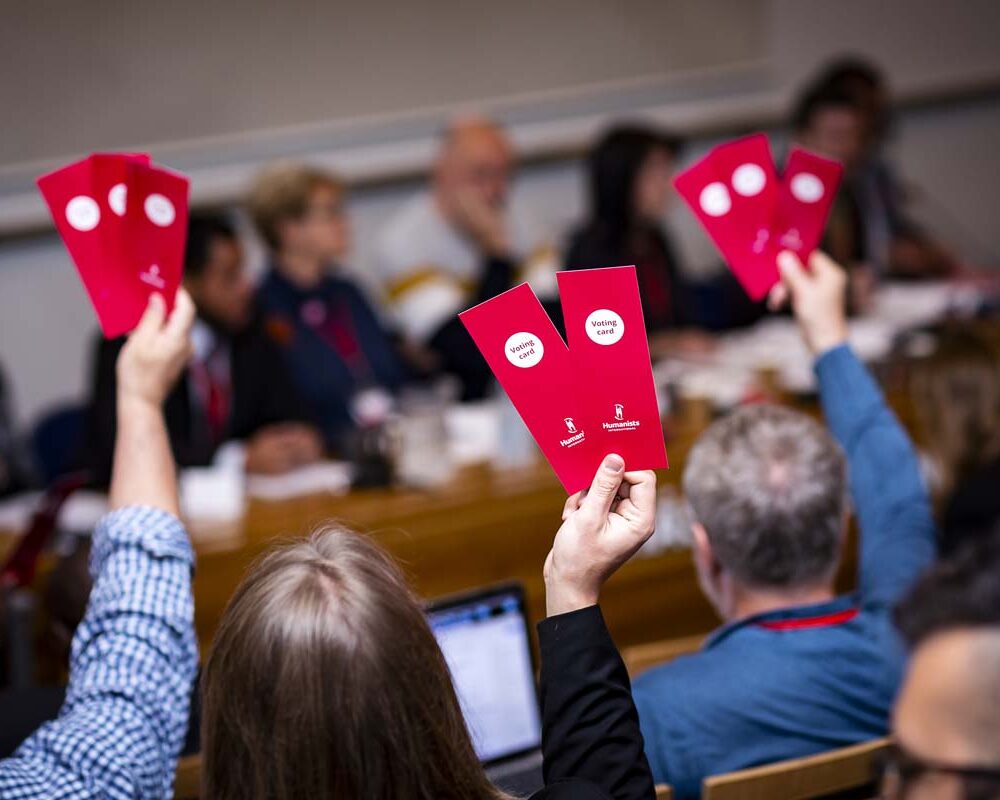
3.10 Full and Specialist member organizations may appoint one or more voting representatives to the General Assembly, up to their voting entitlement by notifying the IHEU office in writing. When a full member has appointed fewer representatives than their voting entitlement, representatives may have multiple votes. The term of office of each individual voting representative shall be at the discretion of the member organisation and all members shall name their representative(s) in writing for each General Assembly.
3.11 Organizations may appoint proxies or representatives from other organizations to vote or act as their representative(s). However representatives of any member organization shall not carry more than four proxy votes between them.
3.12 The quorum for any General Assembly shall be one third of the General Assembly votes present in person or by proxy, providing those representatives are from at least three countries. Votes shall only be taken when a quorum is present.
3.13 Decisions shall be carried by a simple majority of those entitled to vote. When a vote results in a tie, a second ballot shall be taken at once. If the vote should again be equally divided, the Chair shall cast the deciding vote.
3.14 In no case shall member organizations from one country cast more than one third of the total votes available at any General Assembly. Where this event arises the votes from that country shall be reduced to the nearest whole number below the one third threshold. Where more than one member organization represents that country, the Chair shall decide the division of the vote reduction.
3.15 Where a member organization is international in nature, it shall be regarded as representing the country in which its largest individual membership is located.
3.16 Individual supporters of the IHEU and individual members of member organizations may attend the General Assembly as observers, but may not vote and may only speak with the permission of the Chair.
3.17 The annual General Assembly shall elect a President, a first Vice-President, three further Vice-Presidents and Treasurer on a rolling programme as specified under paragraph 4.2.
3.18 The Executive Committee shall submit to the annual General Assembly a report of the activities of the IHEU during the previous year ending 31 December for its approval.
3.19 The Executive Committee shall submit to the annual General Assembly a statement of accounts up to 31 December of the previous year for its adoption. The General Assembly shall appoint auditors.
3.20 The General Assembly may appoint Honorary Associates of the IHEU.
4. Executive Committee
4.1The Executive Committee shall comprise of the President, four Vice–Presidents and a Treasurer (if possible not more than two persons coming from the same country) who shall be Directors or Trustees of the IHEU. The Executive Committee may appoint Senior Staff as appropriate to be non-voting members of the Executive Committee". The Executive Committee shall be responsible for managing the IHEU in accordance with the policy and directives of the General Assembly.
4.2 The term of office of the Executive Committee members shall be three years. One third of the elected Executive Committee members shall retire at each General Assembly, those longest in office retiring first, but shall be eligible for re-election.
4.3 All member organizations have the right to nominate individuals to positions on the Executive Committee. Such individuals shall either be Supporters of the IHEU or members of a member organization. A call for nominations shall be sent out with the notice of the meeting, and with the papers for the meeting. Nominations must be received in writing in the office 30 days before the General Assembly.
4.4 The Executive Committee shall meet at least three times a year to deal with current business, either in person or in a telephone conference. The quorum shall be four members. Business may also be transacted by correspondence or e-mail.
4.5 The Executive Committee may co-opt members to fill vacancies on the Committee until the next General Assembly, at which time they must be formally nominated and elected if they are to continue. The Executive Committee may invite any person to observe or participate in their meetings, but such people shall not have a vote.
4.6 A member of the Executive Committee shall not act as a representative (or proxy) of member organizations at the General Assembly and therefore shall not vote except as the Chair of the meeting under paragraph 3.13.
4.7 The Executive Committee shall appoint IHEU representatives to any appropriate international organisation, and written reports of their activities shall be included in the annual report submitted to the General Assembly.
5. Rules of Membership of the IHEU
5.1 Organizations applying for membership shall do so on the prescribed application form, shall have a purpose consistent with By-law 1, and shall agree with the minimum statement.
5.2 Member organizations shall also be subject to sustained commitment to the purposes of IHEU.
-a) A proposal to expel a member organization must be supported by at least three full member organisations and submitted to the Executive Committee. -b) The member organization concerned shall have three months to prepare a written response to the proposal and has the right to attend and speak at the Executive Committee meeting which considers the expulsion proposal.-c) If the expulsion proposal is agreed, there is a right of appeal to the next scheduled General Assembly, with a right to present that appeal.-d) If the expulsion proposal is not agreed, the Executive Committee shall inform the submitting member organizations and shall report back to the next General Assembly.
5.3 All member organizations shall pay annual dues (due each year from 1 January) by the end of April. The dues are determined by the contributions regulations contained in these By-laws. These contribution regulations shall be reviewed at least every three years, but may be changed at any General Assembly.
5.4 The contribution regulations for the annual dues for member organisations from the developed world are:
5.4.1 Full members shall pay 4% of recurrent income plus 3 British pence per member, plus a surcharge of 15%. The minimum contribution shall be £1,380. The maximum contribution from any member organisation in any year shall not exceed one third of the total amount of membership dues for that year.
Note: considering the widely divergent forms of organisation a completely satisfactory solution or definition of 'recurrent' income can never be given, but the following explanation is for guidance:
A) income from membership subscriptions/contributions/fees shall be included, but amounts paid over to local societies may be deducted. If the membership fee includes a free journal/magazine, costs of production may also be deductedB) income from capital shall be included in recurrent income, unless the capital was given for a certain special purpose
C) income from gifts are not included, unless these gifts pour in so regularly that when drafting the budget one can count upon a minimum income on that accountD) only the surplus of income over expenditure from journal subscriptions, brochures and books shall be counted as recurrent incomeE) government and/or other grants shall be considered recurrent income if they are given for the general aims of the organisation, but not that part that is for expenses for certain purposes/services.5.4.2 Specialist members shall pay £500 per year plus 7 pence per member, plus a surcharge of 15%. The minimum contribution for this category is £690 and the maximum is £2,400
5.4.3 Associate members shall pay £20 plus 20 pence per member, plus a surcharge of 15%. The minimum contribution for this category is £24 and the maximum is £800.
5.4.4 The Executive Committee has discretion to negotiate different arrangements with organisations facing particular difficulties but will report them to the next General Assembly.
5.5Annual Dues for MOs shall be calculated by IHEU once in 3 years (at which time the minimum and maximum dues limits for all classes of membership organisation will be adjusted by the UK cost inflation index); and the Dues will remain valid till the year following the next tri-annual review of the contribution regulations. If member organisations do not supply IHEU with the relevant information, a 20% increase on the previous year's due will be invoiced.5.6 Member organizations who have not paid their annual dues shall not have the right to vote at the General Assembly. Member organisations who have not paid their annual dues for three consecutive years shall be placed on an ‘inactive’ list, and shall have to negotiate suitable fee payments to reactivate membership of the IHEU.
5.7 Member organizations shall submit their audited annual report and accounts to the IHEU and notify IHEU of any changes to their constitution.
6. Sections
6.1 Members can propose to the General Assembly to organise into an IHEU regional section, that can be formed into an independent legal body.
6.2 The IHEU General Assembly may delegate regional policy and representation to the regional section by protocol agreement between IHEU and the regional section.
6.3 A regional section may appoint one non-voting representative to the General Assembly.
6.4 The Executive Committee may recognise secretariats and networks, as sections of the IHEU, with defined terms of reference, to tackle a specialist area of concern to the IHEU. A section may propose to appoint a non-voting representative to the General Assembly and shall provide an annual report of their activities which will inform the Executive Committee’s annual report to the General Assembly.
7. Co-operating Organizations
7.1 A co-operating organization is one which has purposes not in conflict with the IHEU but not sufficiently close for them to apply as a humanist organisation under By-law 2. The General Assembly may decide to form a link with a co-operating organisation to provide mutual support in the pursuit of common goals. The link will normally be one whereby either side may wish to declare a co-operating relationship in public; such a relationship does not carry with it any voting rights or right to attendance at the General Assembly except by specific invitation.
8. Staff
8.1 The Executive Committee shall appoint a Senior Staff member to be the Company Secretary and who shall assist them in managing the organisation.
8.2 Other personnel may be appointed to work either in the office or elsewhere in the world to further the aims of the organisation. Member organizations shall be informed of all such appointments.
9. Congress
9.1 An international congress shall be convened by the General Assembly not less than once in five years. Not less than one year’s notice of date and place of the congress shall be given to all member organisations and individual supporters.
9.2 The Executive Committee shall make the necessary arrangements for the congress with the host organization.
9.3 Resolutions of congress:
-a) The General Assembly shall appoint a Congress Resolutions Committee at their meeting a year prior to the congress. The committee shall include individuals from at least three countries and a member of the Executive Committee.-b) Resolutions to congress may be proposed by member organisations and shall be clearly identified as to their source and shall be accompanied by a statement of the President/Chair of the member organisation, or other authorised person, that the resolution(s) have been duly agreed to by the management/executive committee of the member organisation for presentation to congress.-c) Such resolutions must be submitted to the IHEU office 90 days prior to the opening date of the congress and shall be distributed to member organisations and those attending congress 30 days before the opening of congress. -d) The Resolutions Committee shall decide which resolutions shall be presented to the Plenum of Congress. They may refuse to refer a resolution in whole or in part to Congress and composite submitted resolutions. They shall communicate their decisions, with explanations, to the submitted member organisation before the congress mailing is sent 30 days before the opening.-e) Workshops held at Congress may also present resolutions to the Plenum provided they are approved by the Resolutions Committee.-f) Resolutions passed by the Plenum of Congress shall bind the IHEU only when and if adopted by the General Assembly at a regularly scheduled meeting.-g) A motion to amend a resolution shall state precisely which part(s) of a resolution are to be amended and shall be deposited with the IHEU office or with the Congress office (during congress) at least 24 hours before the Plenum. The Resolutions Committee shall decide whether such amendments shall be put to the Plenum. Resolutions or motions to amend resolutions shall not be accepted from the Plenum.
10. Amendments and dissolution
10.1 The General Assembly can lay down, change and revoke By-laws consistent with the provisions of the Certificate of Incorporation by a two thirds majority on condition that two months notice of the proposed decision has been given to all member organizations.
10.2 A decision to liquidate the corporation may be carried by a two thirds majority of the General Assembly on condition that no less than six months notice has been given to all member organizations together with the reasons for such a proposal and recommendations on the disposal of the assets remaining upon liquidation, being in accordance with the purpose of the corporation and any other consideration arising from the Certificate of Incorporation and subject to the approval of the Supreme Court of the State of New York.